Tibetan Political Philosophy in an Age of Power Asymmetry
The Tibet question today is often framed in terms of human rights, geopolitics, history, sovereignty, and assimilation. Yet such a framing, while relevant, remains insufficient to define the ongoing stalemate of Tibet-Peoples' Republic of China (PRC) dialogue.
The Tibet question today is often framed in terms of human rights,1 geopolitics,2 history,3 sovereignty, and assimilation.4 Yet such a framing, while relevant, remains insufficient to define the ongoing stalemate of Tibet-Peoples’ Republic of China (PRC) dialogue. At its core, the stalemate since 2010 between Beijing and Dharamshala5 reflects a deeper clash—not merely of interests, but of political ontology at core. It is a conflict shaped by competing traditions of political thoughts, divergent understandings of authority, and what may be called conceptual determinism: the underlying assumptions that define what each side considers legitimate, rational, and possible.
To fully grasp this, one must move beyond conventional international relations frameworks and situate the Tibetan Middle Way Approach (MWA)6 within both classical and contemporary Chinese political theory. In doing so, a striking contrast emerges between the governing logic associated with Xi Jinping often interpreted through the lens of Han Feizi’s Legalism and the normative vision of humane authority articulated by Xunzi and revived in modern form by Yan Xuetong through his theory of moral realism.
Dharamshala’s MWA is grounded in a normative belief that political legitimacy must accommodate identity, religion, and culture. It assumes that a stable political order is one that respects pluralism and allows space for civilisational continuity. In this sense, autonomy is not a threat to sovereignty but a condition for meaningful coexistence mainly driven out of the Buddhist tenets of interdependence in particular (Madhyamika Philosophy).7
Beijing, under Xi Jinping, operates within a framework that prioritises unity, stability, and centralised authority in every possible way. This framework shows strong resemblance to the Legalist tradition associated with Han Feizi. In such a system, diversity is often viewed through the lens of risk management rather than moral accommodation. This divergence creates a situation where the same proposal such as genuine autonomy appears as a reasonable compromise to one side (Tibetan) and a latent threat to the other (China’s leadership).
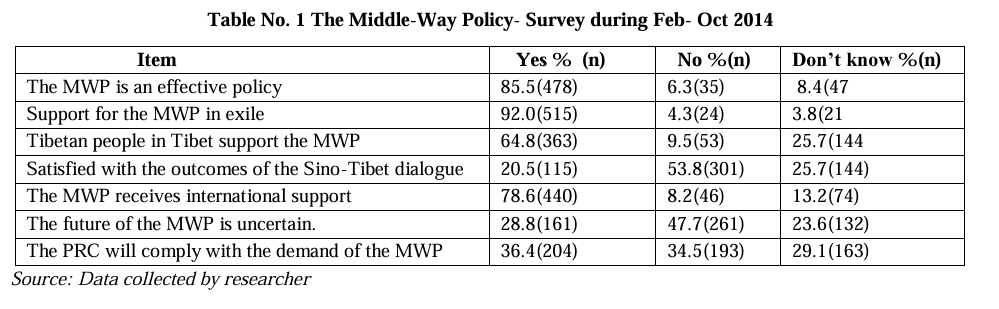
Table 1 presents data from the Middle Way Awareness campaign conducted 12 years ago in 2014. While Tibetan support for the MWA remains overwhelmingly high, the level of satisfaction appears considerably lower. This raises a crucial question: what is required to translate strong support into genuine satisfaction among Tibetans?
Xi Jinping and the Legalist Turn
The governance model under Xi Jinping reflects a synthesis of statecraft such as techno-driven state and classical legalist principles.8 While officially framed within socialist ideology, its operational logic reveals key features of legalism of Shi (authority), Shu (governance) and Fa 法 (Law). While coming to the power, Xi Jinping has centralised all the power authority of the party, the government, and the army. Further, he has deployed his own governance model to bring rivals into line and to silence all dissident voices by using the law (Fa 法) to his own advantage.
This approach is particularly visible in Tibet, where policies aim to assimilate the region more tightly into the Chinese state through the Sinicization of religion, economic development, administrative restructuring, and ideological re-construction in colonial boarding schools. Religion and culture, rather than being treated as autonomous domains, are subject to regulation and reinterpretation in line with state objectives to assimilate and create a sense of oneness of the Chinese nation.9 From a legalist perspective, such measures are rational—they minimise chaos and maximise control. However, they also risk undermining the very legitimacy they seek to secure, since they fail to address the deeper aspirations of the Tibetan people.
Humane Authority: Xunzi and Yan Xuetong Vision
In contrast to Legalism, the Confucian tradition—particularly as articulated by Xunzi—offers a conception of political authority grounded in moral cultivation rather than mere enforcement of law. For Xunzi, effective governance depends on the ethical quality of the ruler and the state, where humane authority (Wang Dao) rests on moral legitimacy, reciprocal relations between ruler and people, and the generation of long-term stability through voluntary compliance rather than coercion.10 Building on this tradition, Yan Xuetong’s theory of moral realism argues that moral authority is a critical component of national power alongside material capabilities. He distinguishes between tyranny (rule by coercion), hegemony (rule by power and alliances), and humane authority (rule through moral leadership and voluntary support), contending that the latter is the most sustainable form as it reduces resistance, enhances cooperation, and strengthens legitimacy.11 Thus, moral realism does not reject power politics but reframes it— positioning ethical leadership as integral to effective and enduring statecraft.
When viewed through the combined lens of Xunzi and Yan Xuetong, the Tibetan MWA emerges as a clear expression of humane authority at the operational level. The MWA does not seek independence or confrontation. Instead, it proposes a framework of coexistence that balances Tibetan identity with Chinese sovereignty. Its core features align closely with the principles of humane authority:
- Moral appeal: It is grounded in non-violence, dialogue, and mutual respect.
- Reciprocal stability: It seeks a solution that benefits both Tibetans and the Chinese state.
- Long-term vision: It prioritises sustainable harmony among ethnicities over short-term gains.
In this sense, the MWA is not a sign of weakness but a strategic calculated choice which I have termed as ‘pragmatic nationalism’. It leverages moral legitimacy as a form of power, aiming to reshape the terms of engagement rather than contest them directly.
Bridging the Conceptual Divide
The key challenge, however, lies in bridging the gap between these competing frameworks. For Beijing under Xi Jinping, influenced by Legalist logic, the Middle Way may appear potentially destabilising to the PRC.12 For Dharamshala, the current approach of MWA is practical and in accordance with the Chinese constitution.13 This is where the concept of humane authority offers a potential bridge. By reframing the Tibetan issue in terms that resonate with indigenous Chinese political thought, it becomes possible to present the Middle Way not as an independence in disguise but as an opportunity to apply the political philosophy of Xunzi to contemporary efforts to solve the Tibet question.14
Adopting elements of humane authority would allow China to: firstly, enhance its domestic legitimacy by addressing Tibetan grievances; secondly, strengthen its international image as a morally responsible power; and lastly, reduce the long-term costs associated with coercive governance. At the same time, such a shift would require a departure from the strict Legalist emphasis on control—a move that is politically and institutionally challenging. However, the existence of such a political thought in the form of humane authority is visible within the Chinese political, according to which the MWA is not an alien to the Chinese state.
The MWA may also provide strategic advantages for Beijing by reducing the enormous and disproportionately high spending associated with stabilising and maintaining politically sensitive regions such as Tibet remains. Studies show that per capita security expenditure in Tibet, Beijing, and Xinjiang is nearly three times higher than the national average.15
Conclusion
The Sino-Tibetan stalemate cannot be understood solely through geopolitics or legal claims, but must be situated within a deeper clash of political ontologies. While Beijing’s governance reflects a Legalist emphasis on control, centralisation, and stability, the MWA embodies a model closer to humane authority, grounded in moral legitimacy, reciprocity, and long-term coexistence. This divergence explains why mutually acceptable solutions remain elusive. However, the presence of alternative traditions within Chinese political thought, particularly those associated with Xunzi and moral realism, suggests that the Middle Way is not entirely alien to the Chinese intellectual framework. Its success ultimately depends on whether future political conditions allow a shift from coercive governance towards a more moral legitimacy-based approach to the Chinese statecraft.
The question, therefore, is whether the MWA is not entirely alien to the Chinese state? Could a shift in Xi Jinping’s political philosophy away from the Legalism associated with Han Feizi enable the future success of the MWA? Alternatively, will such prospects emerge under future Chinese leaders whose political philosophy is more closely aligned with Mencius or Xunzi?
References
- Sen. Rick Scott, Sen. Jeff Merkley Introduce Tibet Atrocities Determination Act. rickscott.senate.gov ↩
- Resetting India's Tibet Policy. FNVA; "Why Tibet? Strategic Imperatives for International Peace and Security." International Campaign for Tibet. ↩
- Lau, Hon-Shiang (2026). Tibet was Never a Part of China since Antiquity: Using China's Official/Authoritative Documents as Proof. ECW Press. Perlego. ↩
- Separated from Their Families, Hidden from the World. Tibet Action Institute ↩
- mwa.tibet.net ↩
- Both the Constitution of the PRC and PRC Regional Ethnic Autonomy Law provide a legal framework that could, in principle, accommodate the genuine autonomy sought by Dharamshala in negotiations with Beijing. https://natlex.ilo.org/dyn/natlex2/natlex2/files/download/35194/CHN35194.pdf ↩
- Ibid. ↩
- licentiapoetica.com ↩
- fnvaworld.org ↩
- King, R.A.H. (2011). Yan Xuetong (阎学通): Ancient Chinese Thought, Modern Chinese Power. Princeton: Princeton University Press. doi.org/10.1017/S0041977X13000335. ↩
- Ibid. ↩
- ccasindia.org ↩
- tibetanreview.net ↩
- However, such an assessment is largely subjective in nature; although, such an outcome is possible where there is sufficient political will. ↩
- Chestnut Greitens, Sheena. (2026). "China's Internal Security Spending: An Assessment of New Data", The China Quarterly, 2026, 1–11. doi.org/10.1017/S030574102610201X. ↩
- Bougon, François. Inside the Mind of Xi Jinping. London: Hurst & Co., 2018.
- Dorjee, Rinzin. "Revisiting the Sino-Tibet Dialogue." International Journal of Social Science and Humanities Research 2, no. 4 (October–December 2014): 259–263. ISSN 2348-3164.