TransHimalaya
Dreshey
Book Reviews
Writings on Tibet, China and the Himalaya.
Jia Luo, Social Structuration in Tibetan Society: Education, Society, and Spirituality
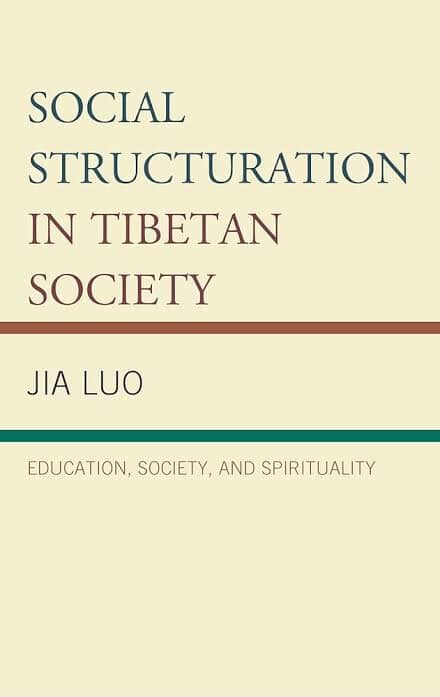
Jia Luo’s Social Structuration in Tibetan Society is an ambitious and theoretically innovative intervention in Tibetan Studies that addresses a long-standing gap in the sociological analysis of Tibetan society by developing what the author explicitly terms a “Tibetan sociology of education,” grounded in both Western social theory and indigenous Tibetan philosophical traditions. Situated within the Emerging Perspectives on Education in China series, the book is framed against two interrelated absences: the marginalisation of Tibetan society within mainstream sociological inquiry, and the dominance of anthropological, historical and political approaches that, while rich in empirical description, have largely failed to conceptualise Tibetan society deeply.
The author’s central objective is to overcome these limitations through a creative synthesis of Anthony Giddens’s structuration theory and the dialectical philosophy of Je Tsongkhapa, offering a framework capable of explaining how spirituality, education, authority and social reproduction interact in a spirituality-centric society such as Tibet. Structurally, the book proceeds from a methodological and theoretical justification of this synthesis to a detailed discussion of Tibetan social organisation before and after the mid-twentieth century, with particular emphasis on the role of monastic institutions, oral communities and state schooling in shaping social continuity and change. One of its most significant contributions lies in its refusal to treat Tibetan Buddhism merely as a belief system; instead, Luo conceptualises spirituality as a constitutive force of social structuration that permeates family organisation, knowledge production, authority relations and educational practice, challenging secular assumptions embedded in much Western sociological theory.
By placing Giddens’s notions of the duality of structure, agency and rule-resource sets into dialogue with Je Tsongkhapa’s distinction between conventional and ultimate reality, the author advances a genuinely interdisciplinary model that neither uncritically universalises Western theory nor romanticises Tibetan tradition. Methodologically, the work is explicitly historical-theoretical, combining extensive textual analysis across Tibetan, Chinese and English sources with qualitative material drawn from unstructured interviews, narrative dialogues and the author’s own lived experience within Tibetan village and monastic contexts. This positionality — as both insider and trained sociologist — allows the author to move beyond surface description and offer a deeper critique of how Tibetan social structures have been destabilised by post-1951 political and educational transformations, particularly the imposition of a state-centric schooling system that marginalises Tibetan language, oral knowledge and monastic pedagogy.
The book’s sustained critique of state schooling is especially compelling, demonstrating how education functions not merely as a neutral instrument of modernisation but as a mechanism of restructuring that fragments traditional social relations, weakens monastic authority, and produces forms of cultural and linguistic alienation among Tibetan youth. At the same time, the author is careful not to idealise pre-1959 Tibetan society, presenting Tibetan social history instead as a dynamic process marked by fragmentation, reconstitution and transformation.
In its final chapter, the book turns to the relationship between education and Tibetan society, describing two forms of traditional education — the oral society, with its village-level social control, and the literate society, which includes the monastic curriculum. For the oral society, it offers strong empirical evidence of how this system maintains social structuration at the micro level, while cautioning about the degradation of oral traditions and urging dialogue between elders and youth to keep them alive. At the macro level, it gives a comprehensive account of the monastic education curriculum and how it has kept Tibetan structuration intact, with monks and nuns as social agents, before critiquing the modern school curriculum for its disruptive effect on both oral and monastic traditions. The author calls for mutual coordination among the three forms of education to foster the Tibetan society’s development, while noting that both oral and literate traditions face challenges from both external and internal factors.
Despite these strengths, the book is not without limitations. At times, the theoretical synthesis between Giddens and Je Tsongkhapa risks appearing novel rather than systematically integrated, particularly when concepts such as “ultimate reality” are extended into the sociological domain without fully resolving the tensions between religious philosophy and social theory. Moreover, while the author is critical of the universalist claims of Western sociology, his reliance on Giddens as the primary external theoretical anchor reproduces a hierarchy in which Tibetan analytical traditions are positioned as complementary rather than co-equal sources of sociological theory. Empirically, the study’s historical-theoretical orientation means that contemporary Tibetan social differentiation — particularly along lines of class, gender and region in post-reform China — receives less sustained analysis than readers might expect, leaving some claims about present-day structuration, including in the exile community, under-substantiated.
Nonetheless, these limitations do not diminish the book’s overall significance in laying the foundations of a Tibetan sociology. Its richness in both theory and empirical evidence may, however, make it difficult for school students and general readers to grasp comprehensively, which could limit their ability to formulate new research questions from it.
The book also opens several new questions, since its data are drawn mostly from inside Tibet: How far is it applicable to Tibetan society in exile in India? What is the structure and agency of Tibetan society in exile, and how far does the Indian national school curriculum reshape the perception, culture and agency of Tibetan youth there? In relation to the author’s suggestion that Tibet’s Epic of King Gesar be included in the school curriculum, is it already taught in schools run by the Central Tibetan Administration, and what would be the advantages and obstacles of doing so? And if a Rinpoche’s intervention in a community dispute fails, how far is it still appropriate to call them a social agent?
According to the author, the literate, monastic tradition of education is one of the fundamental factors behind the lack of social and economic development. Yet in the Tibetan society in exile, monasteries and Buddhism more broadly play a critical role in social development and the political advocacy of the Tibet issue — raising the question of why the change in Tibetans’ legal status to refugees brought Buddhism and monasteries into such prominence, both socio-economically and politically.
In sum, the book succeeds in opening a new analytical space in which Tibetan society can be understood neither simply as a repository of tradition nor a passive recipient of state power, but as a complex, reflexive social formation shaped by the interaction of spirituality, education and agency. For scholars of Tibetan studies, the sociology of education and comparative social theory, it is a foundational text that challenges disciplinary boundaries and invites further empirical and theoretical refinement — recommended for researchers and scholars with an interest in Tibetan studies and sociology in particular.
Stay Connected
Subscribe to our newsletter for the latest stories, insights, and opportunities from the Himalayas.