India-Tibet Cultural Relations and its Legacies
The Tibetan Plateau served as a natural defensive wall for the National Security of Asian countries that did not share borders with China before 1959. China shared land borders with 6 countries before 1959, and India was not among these countries.
The Tibetan Plateau served as a natural defensive wall for the National Security of Asian countries that did not share borders with China before 1959. China shared land borders with 6 countries before 1959, and India was not among these countries. This natural defensive wall collapsed in 1959 with the forceful occupation of Tibet by Communist China. China, now shares borders with 14 countries, with India being one of those.
Tibetan Plateau is the most glaciated region on Earth. Water runoff from these regions feeds the largest rivers of Asia. Closed to 47% of the world’s population depends on the watershed originating from the Tibetan Plateau. Tibet’s strategical, ecological, and environmental significance to the Asian regions is therefore immense.
Tibet also served as a repository of ancient Indian knowledge or wisdom, particularly Buddhist teachings and practices. Pandit Rahul Sankrityayan travelled to Tibet four times between the period 1934 and 1938 in search of ancient Indian knowledge and wisdom preserved there. The Indian population remains largely unaware of how this ancient knowledge and wisdom reached Tibet, and how it has been preserved and cherished by the Tibetan people for over a 1,000 years. This paper aims to present a brief overview of India-Tibet cultural relations and their legacies.
According to traditional Tibetan historical texts, Tibet’s first cultural contact occurred with India sometime in the 4th century CE, during the reign of the Tibetan king Lha Thothori Nyentsan. Buddhism was introduced to the Tibetan king by an Indian scholar named Legjin, assisted by a Khotanese monk and Tokharian translator. The introduction of medical system to Tibet is also attributed to an Indian doctor couple during the reign of King Lha Thothori Nyentsan.
In the 7th century, King Songtsan Gampo (r. 617-650), embraced Buddhism most likely due to the influence of his two consorts: a Nepalese princess named Bhrikuti Devi and a Chinese princess named Wencheng Konjo. The Nepalese princess arrived at the Tibetan Court sometimes around 638 CE, and the Chinese Princess in 641 CE. The Chinese consort brought with her an image of Sakyamuni Buddha, which was installed in the Ramoche temple built by her in Lhasa. The Nepalese consort likewise brought a Sakyamuni Buddha image, which was installed in the temple of Rasa Trulnang, also built by her in Lhasa.
Indian Influence on Tibetan Script and Language
One of the most ambitious and significant tasks facing King Songtsan Gampo was the translation of a vast body of Buddhist literature from Indian languages into Tibetan. Until that point, Tibetan was transmitted orally, as the language had no written script. It became clear that a written Tibetan script with a systematic grammar was essential to accomplishing this goal. King Songtsan had two options: to devise the Tibetan script and grammatical system on either the Indian or the Chinese model. The king chose the Indian model, as the Indian alphabetic script and its systematic grammatical framework were far better suited to translating Indian Buddhist scriptures into Tibetan.
The king dispatched a group of 16 young Tibetans to India to study Indian languages and scripts. Thonmi Sambhota was one of them, and he was the first Tibetan to reach India where he studied Indian languages, scripts, and grammatical texts under various scholars. Based on Indian alphabets and the Brahmi script of the Gupta period, Thonmi Sambhota devised the Tibetan alphabet, script, and grammatical system that remain in use to this day. The Tibetan alphabet consists of 30 basic consonants, including the inherent vowel a, and four vowel-signs – for i, u, e, and o – modelled on the Indian system. He was also the first Tibetan to translate Buddhist scriptures from an Indian language into Tibetan.
No account of the history and development of Buddhism in Tibet would be complete without the mention of Śāntarakṣita, Padmasambhava, and Kamalaśīla—all of whom travelled to Tibet during the reign of Trisong Detsan (r.742-798). Śāntarakṣita’s most enduring contribution was the establishment of the Buddhist Samgha—the monastic community—in Tibet for the first time. In 767 CE, Śāntarakṣita, assisted by 12 bhikkhus invited from India, ordained the first seven Tibetans into the Sarvāstivādin tradition of Vinaya (monastic discipline) and admitted them into the monastic order. He is remembered, honoured, and venerated to this day as the first upādhyāya (khenpo) of the Tibetan Samgha. Through his tireless, life-long devotion and the Royal patronage of King Trisong Detsan, the teachings and practice of Vinaya spread widely across Tibet. On Śāntarakṣita’s recommendation, the king also invited Padmasambhava, one of the greatest tantric masters known in India.
During the same period, the Chinese teacher Mo-ho-yen was imparting instruction in deep meditation remaining in a state of ‘absolute inaction and thoughtlessness’. His teachings diverged, both in theory and practice, from those of the Indian traditions by discouraging the study of the religious and philosophical scriptures. Sharp disputes arose between the followers of the Chinese Spontaneist (cig char ba) tradition and the Indian Gradualist (rim gyis pa) tradition. The Indian philosopher, Kamalaśīla—a disciple of Śāntarakṣita—was brought from India to debate the Chinese teacher. The Chinese master was defeated and returned to his homeland. The king thereupon proclaimed that all Tibetan should henceforth follow the Madhyamika doctrines of the great Indian teachers, such as Nāgārjuna, and conduct themselves in accordance with the 10 religious practices and the 6 paramitas. Kamalaśīla composed Bhāvanākrama (stages of meditation), thereby consolidating and stabilising the foundation of Buddhism laid by Śāntarakṣita and Padmasambhava.
Tibet’s First Monastic Institution and Indian Influences on Tibetan Culture
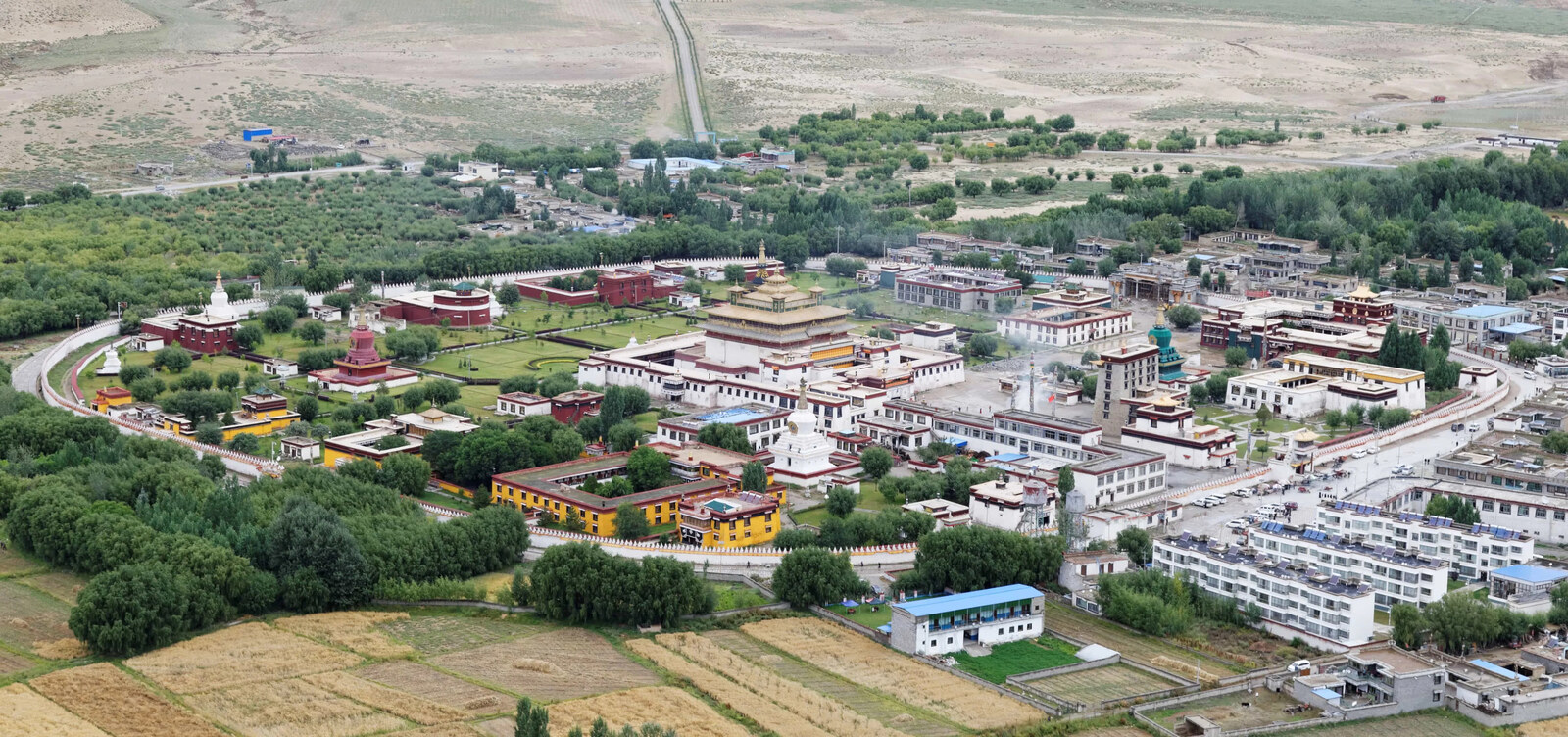
Tibet’s first monastic institution, Samye Mahāvihāra, was built under the patronage of King Trisong Detsan. Acharya Śāntarakṣita, modelled its construction on Odantapuri Mahāvihāra, the ruins of which are believed to lie in and around the modern city of Bihar Sharif in the Nālandā district of Bihar. The Ajanta Cave Vihāras offer vivid evidence that Tibetan monastic architecture is closely reminiscent of the Indian model of Buddhist Vihāras. The Sayanasanavastu chapter of the Vinayavastu—one of the foundational texts on monastic discipline—prescribes the drawing of a bhāvacakra on the front verandah wall outside the main entrance, which is a common feature of Tibetan monasteries. The bhāvacakra is also clearly visible on the front verandah wall of Ajanta Vihāra Cave no. 17, to the left of its main entrance, though unfortunately, a large portion of the painting has been lost.
Of the three catalogues of Indian classical texts translated into Tibetan—compiled in the 9th century—two have survived: the Dankar Palace Catalogue, which lists 736 titles and the Phangthang Palace Catalogue, which lists 959 titles. By the 9th century, the continuous flow of Indian cultural heritage had substantially enriched and transformed Tibetan civilisation, which absorbed these new ideas and adapted them to its own context.
Langdarma, the last Tibetan king, carried out a persecution of Buddhism beginning in 841 CE; religious activities were outlawed, and the entire organisation of faith was dismantled. The political unity of Tibet began to crumble, ushering in an era of decay and dissolution. Cultural interaction between India and Tibet came to a standstill for approximately a century.
Revival of Cultural Relations
The cultural interaction between India and Tibet was revived in the late 10th century as a result of the dedicated and tireless efforts of Lha Lama Yeshe-‘od and the successive kings of western Tibet. Lha Lama Yeshe-‘od and his nephew Jang-chub-‘od despatched Gya Tshondu Senge and Nagtsho Lotsaba to India in search of a teacher who could revive the deteriorating state of Buddhism in Tibet. After a long search and repeated visits to India, they finally concluded that Atīśa (Dīpaṅkaraśrījñāna) was the right person to resolve the Tibetan religious crisis. On numerous occasions, Jang-chub-‘od sent invitations to Atīśa to visit Tibet, accompanied by generous gifts of gold.
Atīśa arrived in Tibet in 1042. He devoted 17 years of his life to Tibet, preaching the Buddha Dharma and translating classical Buddhist texts into Tibetan in collaboration with his Tibetan disciples. He is credited with composing 26 texts—including the bodhipathā-pradīpa, a manual of Mahayana Buddhist practices—and translating 27 Indian classical texts. The wealth that Atīśa accumulated in the form of offerings from the devotees and disciples was despatched to India on three occasions, through Chag Khri-mchog and other disciples, as offerings to his teacher and the monastic community, most probably of the Vikramaśīla Mahāvihāra.
Atīśa emphasised the necessity of an unbroken teaching tradition that could prevent the arbitrary interpretation of sacred texts, which had become a problem in Tibet at that time. The authority and validity of the doctrine had to be guaranteed through direct transmission from masters to disciples. Such direct instruction was held to ensure both the correct interpretation of the scriptures and the right understanding of the spirit concealed behind their words, thus enabling Buddha’s teaching to fulfil its mission of salvation. He is therefore credited with the revival of Buddhism in Tibet.
The period between the 10th and the 12th centuries was a peak era during which many Indian scholars visited Tibet to preach and assist in translation work, while many Tibetans travelled to India to study under Indian scholars. These Tibetans visited the sacred places of the Buddhist tradition in India in order to collect texts, study with the Indian teachers, receive initiation into tantric traditions, and obtain instruction in the oral tradition of mystical and yogic texts as well as tantric practice. Lochen Rinchen Zangpo (958-1055 CE), Marpa Lotsaba, Nagtsho Lotsaba, Gya Tshondu Senge, and Ngog Loden Sherab are among the notable Tibetans of this period who brought and propagated the Indian knowledge and wisdom in Tibet. Rinchen Zangpo travelled to Kashmir and other parts of India on two occasions, returning each time with scriptures, teachers, and artists from Kashmir. He is credited with building 108 temples or chapels, and with translating or revising 158 texts, either alone or in collaboration with Indian scholars.
Some Tibetans even held significant positions at the great Mahāvihāra in India. Tsami Lotsaba Sangye Dakpa became a leader and teacher of the Samgha at Bodhgaya and Nālandā Mahāvihāra. The basic account of Ga Lotsaba’s first meeting with Tsami Lotsaba at Nālandā is given as follows:
“At the Vihāra of Sri Nālandā there dwell many pandits;
And among them also there dwells the one who has obtained Wisdom in the five Major Sciences and the Siddhi of long life;
The one called Tsa-mi Sangye Dakpa.”
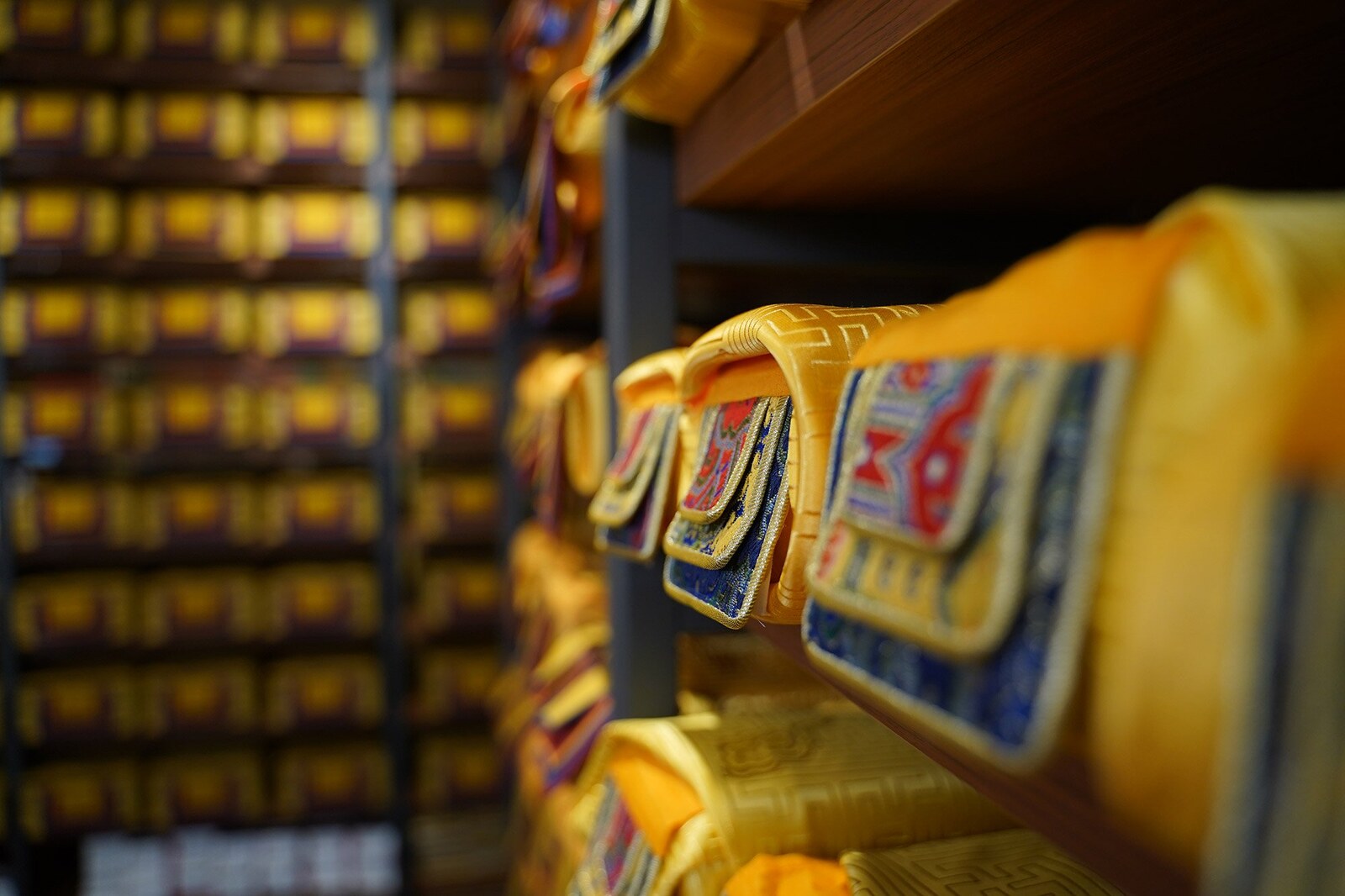
As a result of Tibet’s continuous cultural interactions with India during the given period, Tibetans produced the largest body of translations of the Indian classical literature. The Tibetan Tripitaka, known as Kanjur,1 and Tanjur,2 preserves approximately 5,000 classical texts translated mostly from Sanskrit language.
In addition to the vast number of the translation of Buddhist classical texts of Mahayana and Buddhist philosophical texts preserved in Kanjur and Tanjur collections, there are over hundred non-Buddhist Indian texts covering classical medical, grammar, poetics (Kāvyasāstra), dramaturgy (Nāṭakaśastra), and political science (Nitisāstra), all translated into Tibetan language and preserved in the cīkītsā vīdyā (gso ba rig pa), śabda vīdyā (sGra rig pa), Śīlpā vīdyā (bzo rig pa), and Nitisāstra (lugs kyi bstan bcos) sections of Tanjur collection. These texts are still studied by Tibetans and have exerted the greatest influences in Tibetan literary and medical traditions.
The cultural interaction between India and Tibet gradually diminished from the mid-13th century following the destruction of Buddhism in India by foreign invaders, but it was never entirely severed. Several Indian scholars continued to visit Tibet and collaborate with Tibetan scholars after that period. Notable figures among them include Sariputra, the abbot of Bodhgaya who arrived in Tibet in 1418; Pandit Vanarātna who arrived in Tibet with a group of 14 masters in 1426; and Pandit Buddhaguptanātha, Nirvānaśrīpāda, and Pūrṇāvajrapāda, the principal teachers of Taranatha (1575-1634 ), the author of History of Buddhism in India. The interaction of the fifth Dalai Lama (1617-1682) with Indian pandits is also noteworthy. The visit of Pandit Gokulnāth Miśra and his elder brother Balabhadra in 1655 at the request of the fifth Dalai Lama may have been the final phase of these historic India-Tibet cultural interactions.
The Return of Buddhism and Indian Literary Works to India
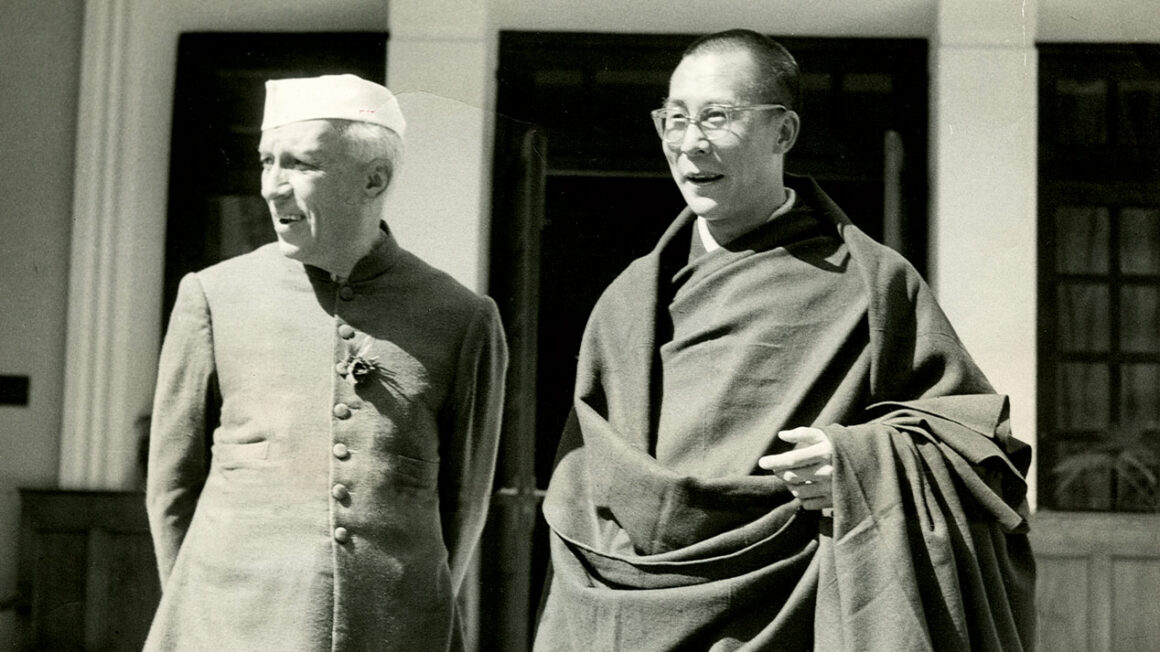
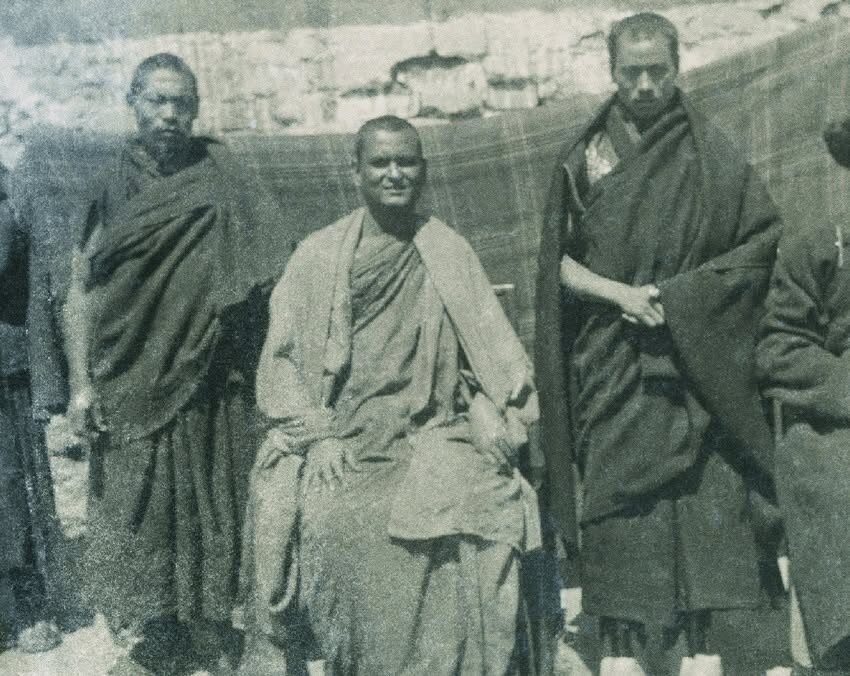
In the early 20th century, Sarat Chandra Das undertook a journey to Tibet on a political mission. A pioneering Indian Tibetologist, he wrote several books on the religion, history, and grammar of Tibetan language, including A Tibetan-English Dictionary with Sanskrit Synonyms, as well as a work on the activities of Indian scholars in Tibet entitled Indian Pandits in the Land of Snow. In 1934, Pandit Rahul Sankrityayan came to Tibet to study Buddhism with Tibetan scholars and to search for Sanskrit manuscript that had left India since the 7th century. He returned to India with photographic copies of approximately 80 Sanskrit manuscripts and 40 horse-loads of Tibetan Buddhist texts. With the arrival of His Holiness the Dalai Lama and the Tibetan refugees in India in 1959, Buddhist culture and values that had long disappeared from their land of origin were once again restored to India.
Conclusion
As a result of Tibet’s continuous cultural interactions with Indian scholars, Tibetans have produced the largest number of translations of Indian classical texts. The Tibetan Tripiṭaka, known as the Kanjur and Tanjur, preserves approximately 5,000 titles translated from Indian languages. The Tibetan people have proved to be exemplary custodians of Indian cultural values, particularly Buddhism and Buddhist philosophy, inherited and transmitted from India over a period of 1,000 years. His Holiness the Dalai Lama and Tibetan scholars in exile have made a remarkable contribution to propagating Buddhist values—particularly Mahāyāna teachings and Buddhist philosophy—in India as well as the wider world.