India and the Tibet Question: Shelter, Strategy, and the Future of Policy
The Tibet question unfolded very gently, almost imperceptibly, for India during its early years of independence.
The Tibet question unfolded very gently, almost imperceptibly, for India during its early years of independence. When China invaded it in 1950, India was still preoccupied with the aftermath of Partition and the war with Pakistan. It adhered to the British precedent, recognising China’s suzerainty over Tibet, but appealing to it to respect its autonomy and avoid using force. Tibet’s appeal to the United Nations (UN) was brought before the General Assembly by El Salvador. India and the United Kingdom sought postponement on the ground that talks were taking place between Tibet and China. The resolution was shelved. Prime Minister Nehru looked at the Tibet question through the prism of the Cold War and, even though he accepted that a tragedy was being enacted there, he took China’s assurances at face value. India facilitated the travel of the Chinese general, Zhang Jingwu, to Lhasa through Kolkata. Cooperation with China in promoting Asian resurgence in a new post-imperial world remained the central pillar of India’s foreign policy through the 1950s
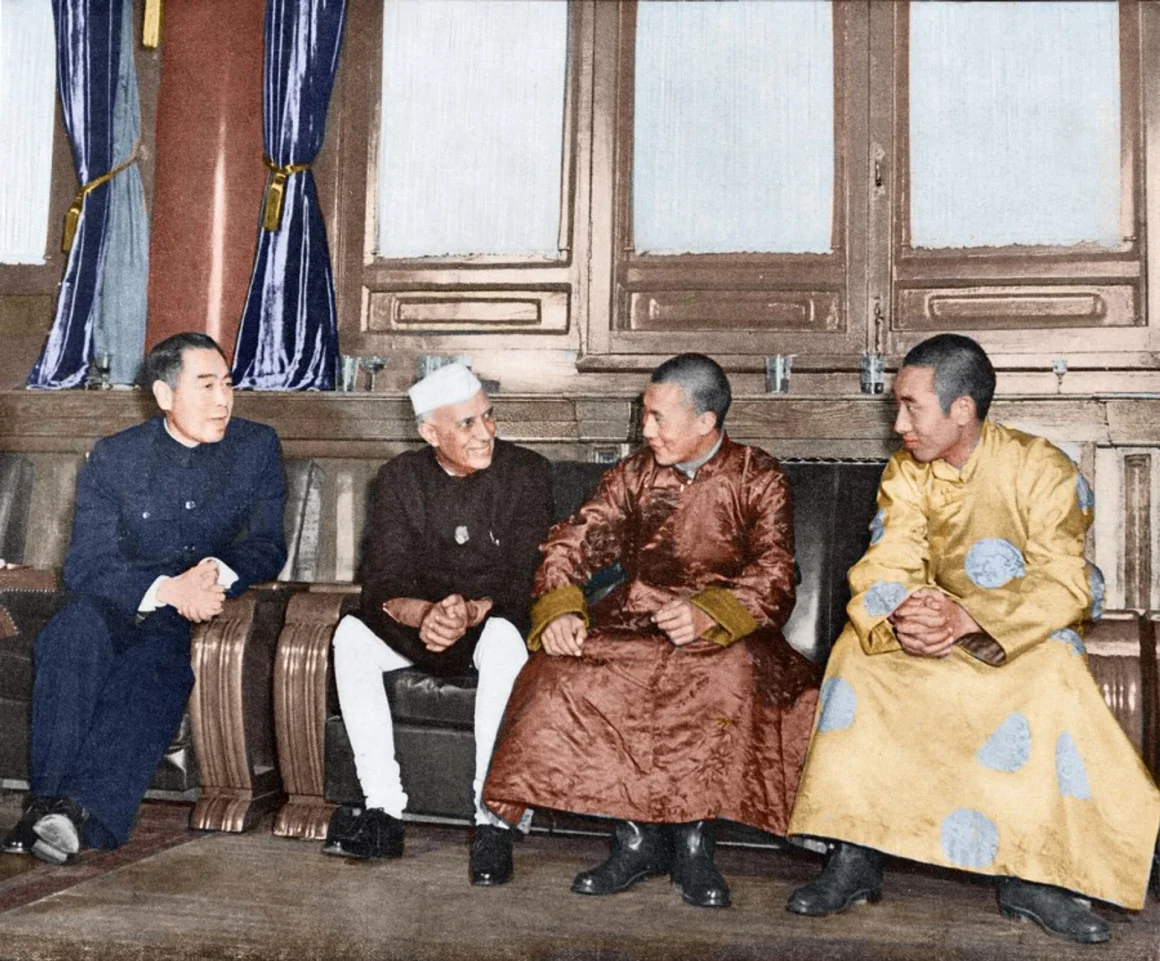
All three countries made efforts to keep their relations going. Tibet accepted a 17-Point agreement offered by China, promising to respect its autonomy, culture and politico-religious institutions. India gave up the extra-territorial rights it had inherited in Tibet from the British and accepted Zhou Enlai’s proposal to convert the Indian mission in Lhasa into a consulate. The Dalai Lama visited Beijing in 1954, as did Nehru. Two years later, Zhou Enlai attended celebrations in Delhi marking the 2,500th anniversary of the Buddha. The Dalai Lama also participated.
This bonhomie was short-lived. China’s repressive policies led to a revolt in Tibet and the flight of the Dalai Lama with thousands of compatriots to India in 1959. China’s reaction to India giving asylum to the Dalai Lama was fierce. It criticised it as an unfriendly act – a violation of Chinese sovereignty and the Panchsheel agreement. It accused India of harbouring imperial designs on Tibet, dismissing its protestations that the asylum had been given to the Dalai Lama as a revered religious leader who would not be allowed to indulge in anti-China activity. China raked up the border dispute, questioning the McMahon Line and claiming all of what is now Arunachal Pradesh.
Prime Minister Nehru tried to address China’s concerns. He persuaded the Dalai Lama not to settle in Kalimpong, the hub of Tibetans in India, sending him initially to Mussoorie and then to Dharamsala. But the enormity of China’s action and its consequences were not lost on him. “It would be a tragedy not only for India and, and possibly for China, but for Asia and the world if we develop some kind of permanent hostility,” he said in Parliament.1 Tragically, this is exactly what happened. China’s invasion in 1962 shattered the dream of India-China friendship.
Meanwhile, India had the task of providing for the rapidly increasing numbers of Tibetan refugees. It accommodated them in 45 settlements spread over 10 states. Providing employment, healthcare, and education became the top challenges, in addition to protecting their cultural heritage and traditions. Tibetans were encouraged to manage their settlements themselves and set up schools where their children could be provided education in a Tibetan setting. The Dalai Lama also ensured that the children got modern education that would prepare them for the new world they were growing up in. He went a step further and started promoting democratic institutions, such as an elected parliament and cabinet. He eventually abdicated his temporal powers in favour of the Central Tibetan Administration (CTA), which he had set up.
The Tibetan administration functions as a government-in-exile in managing the affairs of Tibetans living in India and coordinating with those living in other countries. It also speaks on behalf of all Tibetan people and maintains relations with various countries. However, no country, including India, recognises it as a government-in-exile.
The Tibetan refugees have integrated seamlessly in India, living in harmony with local communities and contributing to the general welfare. They have imbibed the enlightened outlook of their leader, the Dalai Lama, which has enabled them to adapt to new places and changing times, both in India and abroad.
However, the challenges they face remain huge. Problems relating to owning land, running businesses, getting employment, and travelling abroad persist. India does not have a refugee or asylum law, even though it hosts refugees from all its neighbouring countries. It deals with them through ad hoc administrative measures. The Central Tibetan Relief Committee set up by the Dalai Lama coordinates activities with various government departments at the Centre and in the states. The Home Ministry issues Registration Certificates, with duration varying from 1 to 5 years, as identity documents to Tibetan refugees. For travel abroad, the Ministry of External Affairs issues Identity Certificates, renewable every 10 years. Tibetan refugees are entitled to government welfare schemes meant for Indian citizens such as the public distribution system (PDS), rural housing, health and employment schemes, and they can take up employment in several non-government sectors. In 2014, the Home Ministry issued a Tibetan Rehabilitation Policy to streamline these facilities across states, since most of these schemes are implemented through state governments. However, the implementation of the policy is patchy and leaves much to be desired.
Tibetan refugees can acquire Indian citizenship under certain conditions but few do so because it will weaken their cause and the movement for their homeland, and deprive them of their refugee benefits. The population of Tibetans in India has been shrinking in recent years due to migration abroad for better opportunities and the hardening of the border by China, making it very difficult for Tibetans to escape.
Coming back to the UN, the El Salvador resolution was never taken up again, but the Tibet question was brought up by some other countries in 1959 and later in 1961 and 1965, raising the destruction and human rights violations taking place there. The 1961 resolution also asserted Tibet’s right to self-determination. India abstained on the first two resolutions and supported the third. Tibet’s hopes of assistance from the UN vanished once China replaced Taiwan as a permanent member of the Security Council. The human rights violations in Tibet came up briefly in the Commission on Human Rights in 1991, but with most countries, including India, reluctant to take on China, even on human rights, the openings to raise the Tibetan issue internationally have withered away. It remains a cause taken up occasionally by the civil society.
The issue of the Dalai Lama’s succession has now become a major concern for the Tibetan people and their sympathisers. Even though he no longer holds any political authority, his leadership remains the biggest source of inspiration and solace for the Tibetan people. Their peaceful struggle has drawn universal admiration and sympathy in great part due to his spiritual standing and political sagacity. China is aware of the political significance of the institution and claims proprietorship over it with the cynical intent of using it to undermine the Tibetan struggle.
India has declared that the succession issue is a purely religious matter in which governments should not interfere. Several other countries have taken the same line. It will be important in the coming years for countries and the Tibetan people in exile to continue their support for the CTA and protect the religious sanctity of the institution of the Dalai Lama. India will have to gingerly guide the Tibetan community through this transition and also ensure that their international support does not flag. Tibet has historically been India’s largest and friendliest neighbour. Restoring that peaceful coexistence in an acceptable political arrangement with China is one of India’s biggest foreign policy challenges and will be the key determinant of their relations.
References
- Jawaharlal Nehru, 'Statement in Parliament on 4 September 1959', in India's Foreign Policy, New Delhi, Publications Division, Government of India, 1961, p. 344. ↩