Tenshug Offering: Ritual as Action for the Tibet Cause
On 11th March 2026, Tibet Support Groups (TSGs) from across India gathered in Dharamshala to offer a Tenshug to His Holiness the 14th Dalai Lama, Tenzin Gyatso.

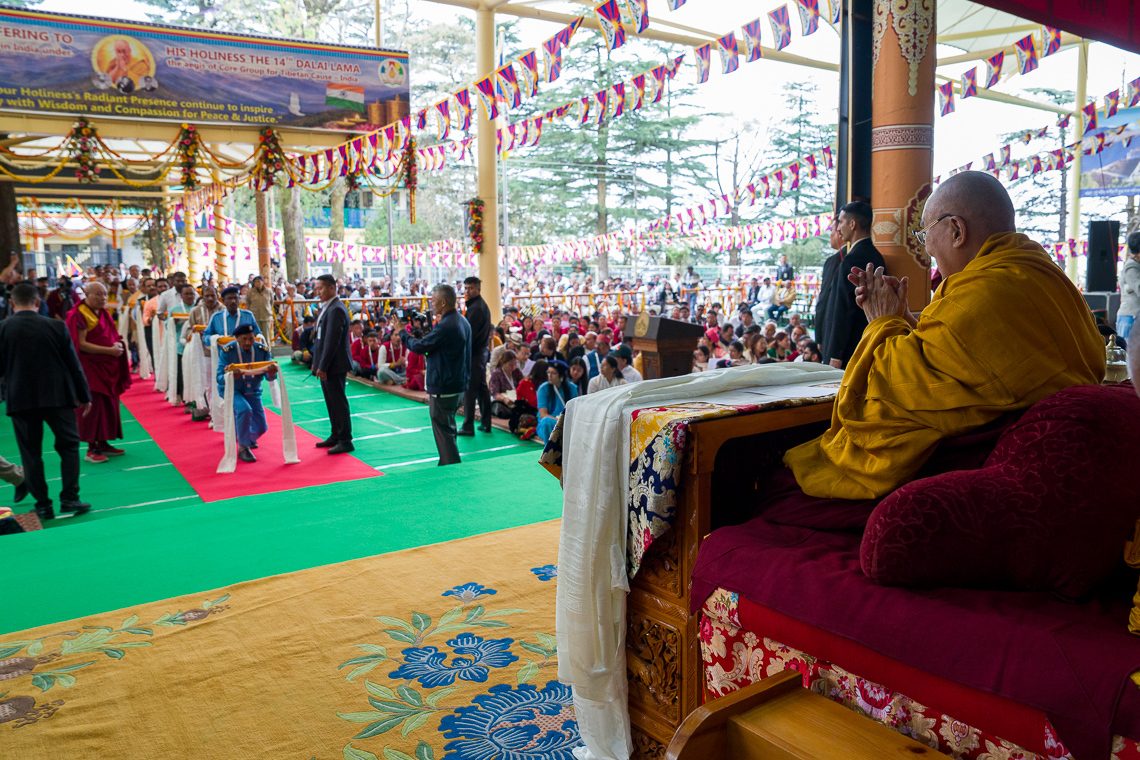
On 11th March 2026, Tibet Support Groups (TSGs) from across India gathered in Dharamshala to offer a Tenshug to His Holiness the 14th Dalai Lama, Tenzin Gyatso. While conventionally a religious act expressing devotion and a wish for longevity, TSGs approached the Tenshug as a considered action in addition to a prayer. In this construction, ritual produces social and political effects. Tenshug becomes a mode of intervention through which civil society reaffirms collective commitment to the Tibetan cause and deep regard for His Holiness.
Civil Society Formation for the Cause of Tibet
Participation of TSGs in the Tenshug reflects their long history of engagement with Tibet since the watershed events of 1959. Over time, the movement has evolved from dispersed expressions of solidarity into coordinated efforts. The formation of the Core Group for Tibetan Cause–India (CGTC-I), constituted under the guidance of venerable Prof. Samdhong Rinpoche, represents institutional consolidation aimed at strengthening coordination. The Tenshug offered by the TSGs reflects maturation.
Participation of 450 delegates—women and men from diverse regions, and belief systems—underscored the extensive support for the Tibet cause among the Indian civil society. Contributions to the commemorative souvenir by those unable to attend extended participation beyond physical presence, creating a wider community of engagement within the movement.
Time Frame and Commemorative Layers of Tenshug Offering
The timing of the ceremony added meaning, as it took place between 10th March, marking the Tibetan Uprising of 1959, and 12th March, commemorating the Tibetan Women’s Uprising Day, situating the event within a spectrum of resistance and gendered expression.
The Central Tibetan Administration (CTA) designated the year 2025–26 as the ‘Year of Compassion’ to mark the 90th birth anniversary of His Holiness the Dalai Lama. Compassion is raised from a personal ethic to a value for collective action. The Tenshug, therefore, linked past sacrifices, present commitment, and continuity in the future.
Ritual as Action
Alternative forms of engagement emerge when formal diplomatic engagement is circumspect. In this setting, this ancient ritual functions as an action; it represents and shapes social realities.
In the language of movements, this Tenshug exemplifies ritual as action, where collective participation produces social and political effects. Through ritualised offerings, shared texts, and embodied presence, participants reinforced shared values and commitments without confrontation, reflecting what Erving Goffman describes as the significance of co-presence in structuring social action. Drawing on Clifford Geertz, ritual may be understood as a system of meaning and a mechanism through which coherence and legitimacy are produced.
Moments were organically built to enable all the delegates to be in the presence of His Holiness, the 14th Dalai Lama. The presentation of the auspicious gifts, the ‘Khatags’, the ‘Bua’ presenters, culminating in the personal meeting of each of the 450 delegates with His Holiness, stamped an experience of a lifetime.
Importantly, by reaffirming commitment, the ritual acts as a stabilising intervention, sustaining the moral and institutional coherence of the Tibetan cause.
The Karuṇā Ratna and Ethical Expression
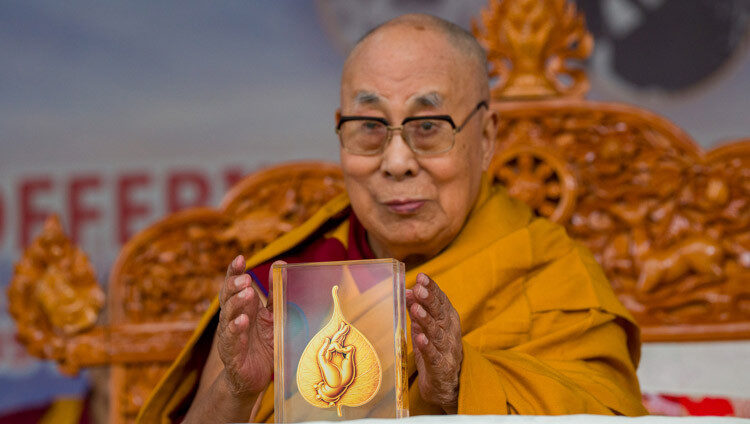
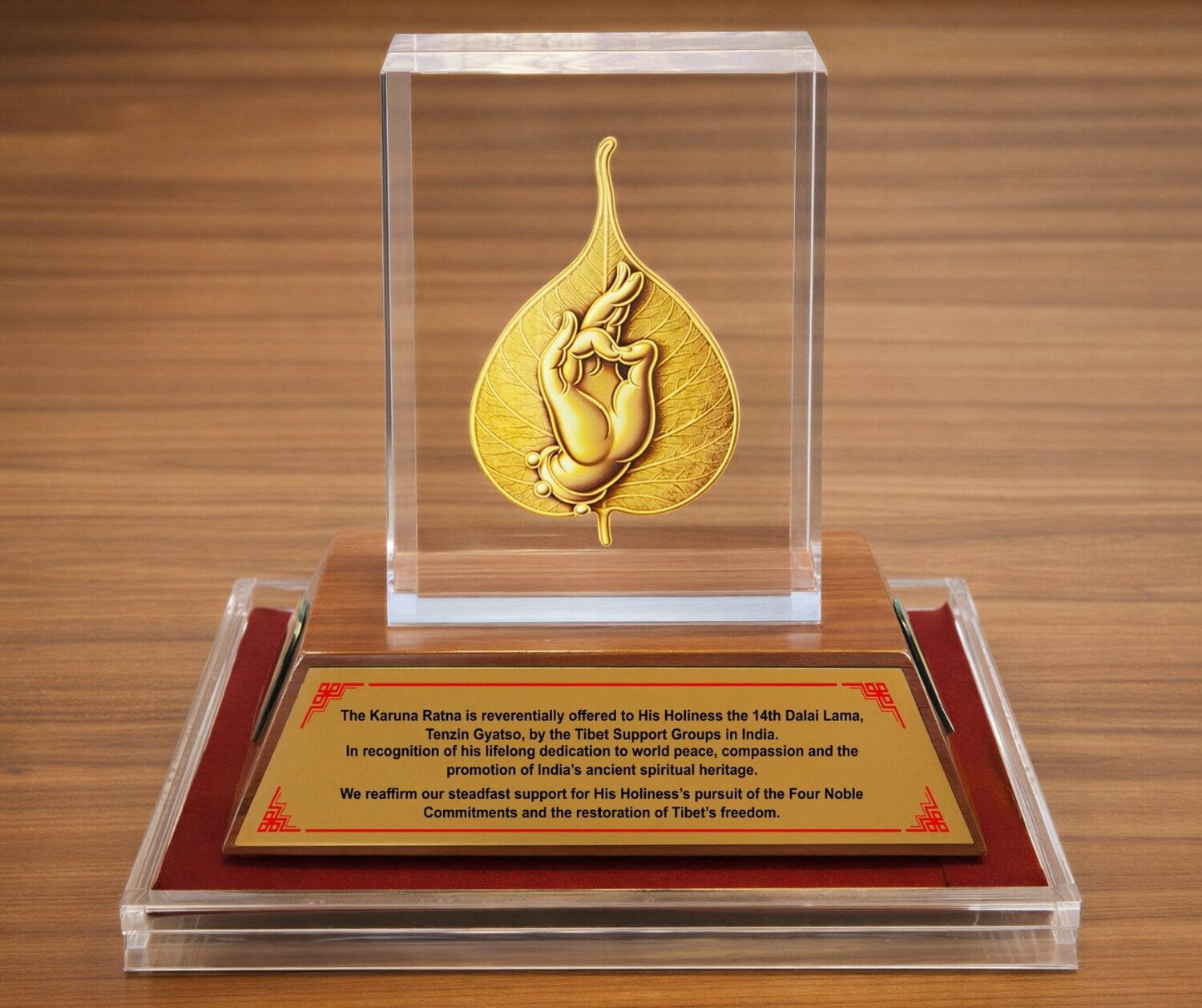
Central to the ceremony was the offering of the Karuṇā Ratna (Jewel of Compassion), symbolised through a beautifully crafted token encased in crystal. The accompanying scroll defined compassion as “courage in action and responsibility towards all beings,” extending karuṇā into an ethic of engagement. Compassion here is active and linking spiritual values with social responsibility.
Invocation of India as the soil of offering, in the scroll, situated the act within a shared civilisational ethos shaped by karuṇā and ahiṃsā. References such as ‘Sarve Bhavantu Sukhinah’ and ‘Sarva Maṅgalam’ reinforced a shared ethical lexicon.
Voice and Collective Commitment
The ceremonial scroll read on behalf of the TSGs by the CGTC-I articulated the importance of the Dalai Lama’s presence as a source of resilience for Tibetans, a revered teacher in India, and a global moral voice. His life was described as a bridge between suffering and dignity, and exile and belonging.
The pledge read on behalf of the TSGs reinforced the above expression. Delegates pledged to highlight, at all appropriate platforms, the importance of dialogue between representatives of the Dalai Lama and the People’s Republic of China (PRC). They also pledged to uphold the continuity of the institution of the Dalai Lama and to articulate the Tibetan cause across national and international fora. This pledge constitutes an act of collective affirmation.
Spatial Significance: Dharamshala as Site
The location amplified the meaning of the Tenshug offering. Dharamshala is the locus of a spiritual centre and political site as it is the residence of the Dalai Lama and the seat of the CTA. The Tsuglagkhang Temple complex represents the institutional heart of Tibetan life in exile. The presence of the Sikyong, Kashag members, Ama Jetsun Pema la, and other key dignitaries was a recognition of the partnership with the TSGs of India.
The location enacted continuity despite displacement, anchoring the Tibet cause within a lived geography and reinforcing its legitimacy.
Creative Civil Society Engagement
The Tenshug highlights how civil society engages creatively within structural constraints. This ritual provides an alternative mode of engagement and strong communication. At the same time, the event reflects India’s calibrated position on the Tibetan issue. While the state maintains diplomatic caution, civil society engagement remains active, sustaining the moral presence of the Tibetan cause in the civic sphere.
Continuity and Leadership
The offering of Tenshug signifies a collective effort to reduce uncertainty, especially among Indian supporters of the Tibetan cause. This Tenshug offering to the Dalai Lama reflects both reverence and the criticality of the present moment. The pledge affirmed the present while preparing for transforming into a collective resolve.
Tenshug offered by Indian TSGs concluded with carefully curated cultural performances from states in the North-East and South of India. The Tenshug thus becomes a prayer for longevity and a reiteration of commitment towards the Tibetan cause.
Conclusion
I have been a supporter of the Tibetan cause since my early days and as the founding President of the Women’s Wing of India Tibet Friendship Society (ITFS), I have had the good fortune of meeting His Holiness the Dalai Lama and receiving guidance from him. I have reached the Gelugpa lineage through political action. For the Tibet cause, I have advocated creatively at every opportunity, even during my professional work in other countries.
For me, offering of the Tenshug by TSGs’ on 11 March 2026 presented a moment to revitalise support among Indian TSGs, even the Karuṇā Ratna, conceptualised by the women advocates of TSGs, reflected a deep understanding of its significance. It illuminates ritual transforming into action within civil society engagement. The event created a space where ethic and political aspiration converged through ceremonial offerings and participation of Indian TSGs.
References
- Central Tibetan Administration (CTA). (2025–26). Communication on the 90th Birth Anniversary of His Holiness the 14th Dalai Lama and the Year of Compassion.
- ——. (2025). Statement Affirming the Continuation of the Institution of the Dalai Lama, 2 July.
- Gaden Phodrang Trust. (2025). Statement on the Continuity of the Institution of the Dalai Lama.
- Office of His Holiness the Dalai Lama. (2026). Prayers for His Holiness's Long Life Offered by the Core Group Supporting the Cause of Tibet in India.
- Core Group for Tibetan Cause – India. (2026). Tenshuk Souvenir.
- Geertz, Clifford. (1973). The Interpretation of Cultures. New York: Basic Books.
- Goffman, Erving. (1963). Behaviour in Public Places: Notes on the Social Organization of Gatherings. New York: Free Press.