China’s Digital Repression
Surveillance in Tibet is often described as 'Orwellian', reflecting the alarming reality of China's extensive digital population control system.


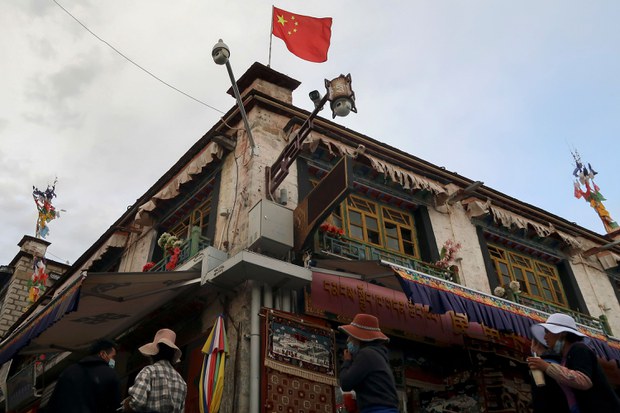
Surveillance in Tibet is often described as ‘Orwellian’, reflecting the alarming reality of China’s extensive digital population control system. This apparatus represents one of the most sophisticated and comprehensive forms of surveillance seen in the modern world. Across the Tibetan plateau, what has been systematically established transcends traditional coercive measures; it is a multi-layered, artificial intelligence (AI)-driven architecture that meticulously monitors communications, regulates movement, and pre-emptively suppresses political dissent. By employing predictive, algorithmically-triggered enforcement, this system effectively stifles opposition before it can emerge, posing significant implications for human rights and freedoms in the region.
The chief architect of this transformation is Chen Quanguo, whose appointment as Tibet Autonomous Region (TAR) Party Secretary in 2011, initiated the systematic institutionalisation of digital securitisation. Within two months of assuming office, Chen introduced a dense network of ‘convenience police stations’ that by 2016 numbered over 700 across urban and semi-urban centres, each integrated with police databases for automated, continuous surveillance. Beyond conventional security forces, the Party constructed an interlocking apparatus combining military presence, police networks, ‘grid cell’ system, and double-linked household management structures that institutionalised neighbourhood-level monitoring at unprecedented control.
Staff members of the Central Tibetan Administration, Tibetan civil societies, advocacy groups, and their activists born in Tibet and affiliated with these institutions, frequently face a difficult choice: continue serving the Tibetan cause or maintain contact with their families in Tibet. Unable to silence these exiles directly, the Chinese government instead targets their family members and pressuring them to compel their relatives abroad to resign from their positions and refrain from political involvement entirely. Families are thus weaponised as instruments of repression and a direct threat of state retaliation.
When Chen was transferred to East Turkistan in 2016, he replicated Tibet’s entire securitisation framework within a single year, compressing into 12 months what had required 5 years to construct in the TAR. In East Turkistan, the Tibetan model was not merely reproduced but technologically escalated. The repression of Tibetans was never a localised or improvised policy. Instead, it constituted the research and development (R&D) phase of a systematic project of ethnic subjugation, one in which Tibet provided the proof of concept that was replicated in East Turkistan.
The Architecture of Total Surveillance: Infrastructure, Biometrics, and Behavioural Control
The technical infrastructure bolstering this system is considerable in both scale and sophistication, and its deliberate architectural consistency makes it qualitatively different from mere surveillance. China has deployed hundreds of thousands of 5G networks enabling hyper-precise geolocation capabilities that feed into extensive networks of facial recognition cameras capable of identifying and tracking individuals across vast geographic areas in near real time. These systems have been integrated with deoxyribonucleic acid (DNA) databases, Global Positioning System (GPS) tracking infrastructure, and internet activity logs to produce a fused biometric surveillance state of unprecedented range.
Tibetans are required to install government-mandated applications (apps) on their devices, officially promoted as anti-fraud tools, but functioning in practice as persistent surveillance instruments. These apps grant authorities ongoing access to call logs, contacts, location data, and core device functions.
Dhondup, a resident of Central Tibet whose name has been changed to protect his identity, speaks candidly about the psychological weight of living under this system. He says: “I feel unsafe using my phone” and “I feel constantly watched and monitored by an invisible algorithm.”
He is unequivocal about the true nature of these tools. He further says: “These apps are not protective measures” and that “They are instruments of control, installed without consent”. The consequences, he explains, run deeper than surveillance alone. “We self-censor. We become more cautious, more surveil, about everything we say and share”. His words reflect a broader reality: a community living not just under watch, but where distrust of the system has become part of daily life, and fear has quietly reshaped the way people speak, connect, and exist. It reveals how the architecture of control aligns with extensive surveillance practices and could aid the Chinese government’s efforts in controlling them.
The collection of biological data has proceeded alongside this digital dragnet. According to Citizen Lab research, from 2022, approximately one-third of the Tibetan population has had their DNA extracted without informed consent. Iris scans, voice samples, and genomic profiles are held in state databases whose scope continues to expand, meaning the state does not merely know where a person is, but who they biologically are, permanently. This logic extends to physical space as well. Drone monitoring of border corridors, particularly the high Himalayan passes toward Nepal historically used by Tibetan refugees, has reduced crossing attempts to near single digits, a closure enforced through unmanned aerial vehicle (UAV) patrols and sensor networks that rendered lethal border enforcement largely unnecessary. Containment, in other words, has been technologised to the point where it no longer requires visible violence to be total.
Information Warfare, Transnational Repression, and the Global Proliferation of the Tibetan Model
The Chinese Communist Party (CCP) operates a deliberate, sophisticated, and escalating campaign of transnational repression targeting Tibetans in exile, a campaign designed to overshadow dissent through digital surveillance, systematic intimidation, and calculated threats against relatives still inside Tibet. Tactics include the pervasive monitoring of exile activities, coerced repatriation of diaspora members, cyberattacks on Tibetan institutions, and the sustained harassment of those who dare to advocate for human rights on the international stage.
For many Tibetan exiles, severing family ties is not a choice freely made, it is a sacrifice brutally extracted by an external factor. Maintaining contact carries grave consequences, directly exposing their families to interrogation, surveillance, detention, and punishment. And so, to shield their families from harm, they choose to stay at distance and silent over the ordinary comfort of human connection. Tragically, many Tibetans who fled Tibet have never received a single word from their families since the moment they departed, carrying that profound absence with them every single day of their lives. It is a deliberate, systematic strategy designed to isolate, exhaust, and ultimately break the spirit of those who dare to speak for Tibet.
The digital infrastructure of that control is continuously expanded and refined. By 2019, Beijing was offering rewards of 300,000 yuan, over $42,000, for information leading to the arrest of social-media users deemed disloyal to China. The move was deliberate in its logic: by monetising surveillance, the state effectively crowdsourced ideological enforcement, transforming ordinary citizens into instruments of digital policing. The machinery no longer required centralised monitoring of every account, it required only that users internalised the possibility of being watched and reported by anyone around them. The ultimate output of this surveillance architecture is engineered self-censorship, a condition in which the state need not silence every voice directly. It needs only to make enough people afraid that the rest silence themselves. In this sense, the technology of control is not merely a tool of repression; it is a system designed to make repression self-executing.
China’s effort to shape information operates in parallel with, and as a deliberate extension of, its physical surveillance infrastructure. A government-employed network of online commentators, commonly referred to as the ‘50 Cent Army’, is estimated to number between 500,000 and 2 million operatives proficient across multiple languages and platforms.
The Centre for Information Resilience has documented extensive coordinated networks operating across major Western platforms, promoting pro-Beijing narratives and systematically discrediting criticism of Chinese policy through artificially generated profiles, compromised accounts, and synchronised posting activity. Search engine optimisation has been deployed as a refined instrument of political influence, with state-backed media systematically elevated in results for geopolitically sensitive queries, embedding official narratives within the information architecture that international audiences depend upon for basic orientation.
Chinese firms have supplied surveillance systems to more than 80 countries with documented poor human rights records, and China now holds approximately 40 per cent of the global video surveillance market, with exports valued at approximately $9.8 billion in 2023. Hikvision alone operates across more than 150 countries and regions, and concerns over the intelligence-gathering potential of Chinese surveillance hardware have prompted sanctions, bans, and procurement restrictions in the United States, the United Kingdom, Australia, and several European Union member states.
Tibet functions as a laboratory in which the operational limitations of total digital governance have been established. The international community faces a narrowing window in which to develop effective countermeasures, establish enforceable norms, and restrict the further proliferation of cutting-edge technologies. The experience of Tibetans governed not by soldiers but by algorithms, not by law but by anticipatory data base systems, constitutes both a precise forecast of what AI-enabled authoritarian governance looks like in sustained practice.
In conclusion, the developments in Tibet signify a profound shift in surveillance and control mechanisms, surpassing traditional boundaries. The use of advanced technologies cultivates an environment where silence becomes the only viable expression. This engineered quietude exemplifies contemporary authoritarianism, Operating covertly and overtly to suppress dissent without leaving visible scars. As these methods gain traction globally, they challenge the discourse on freedom and human rights. The lack of adequate language to describe these dynamics highlights the urgent need for a collective response, as the silence surrounding dissent may be a deliberate aspect of this emerging paradigm.