Tibet in the Year 2048
Let us make a leap into an imaginary future, to the year 2048: the Peace Zone Tibet has become reality. This could be the premise of an admittedly optimistic scenario for Tibet and Asia as a whole.
Let us make a leap into an imaginary future, to the year 2048: the Peace Zone Tibet has become reality. This could be the premise of an admittedly optimistic scenario for Tibet and Asia as a whole.
We want to enrich the core of this ‘utopian’ scenario with a few logical additions: in a further development of the Peace Zone concept, I extend the Dalai Lama’s proposal to all of Inner Asia. Only then—when it passes, so to speak, an expanded proof of validity—does it acquire genuine geopolitical sense. The Tibetans, together with the Mongols and the people of East Turkestan, could form the core of an Inner Asian federation, underpinned by security guarantees from the surrounding great powers China, India, and Russia, and supported by the United States (US).1 The entire Inner Asian space could thereby be demilitarised, becoming the cornerstone of an age of Pax Asiatica.
This would need to be preceded by a fundamental shift in consciousness, in which India and China recognise that their security is decisively linked to a reordering of their geopolitical spaces and interests—and Inner Asia is part of that. An end, too, to the oscillation between hollow balance-of-power politics and nationalist imperial fantasies. This would also entail the admission that neither India nor China has succeeded in developing a vision for Inner Asia that served their own security interests, in the period after World War II.
What may be required to reach this moment of recognition is perhaps a profound crisis and the catastrophe of a war—triggered by a dispute over the water resources of the Brahmaputra, the India-Tibet-China border, or the dominance of an artificial intelligence (AI). The prevailing belief in the formation of national empires will have to be displaced, ‘on the day after the day’, by the courage for interstate cooperation and thus a greater degree of political complexity.
By 2048, we already have a reincarnation of the Dalai Lama.2 The succession process has been comparatively smooth—unlike the succession struggles that have long unsettled China. The new Dalai Lama—or perhaps it will even be a girl—becomes a new bearer of hope, inspiring Tibetans and the world alike. The young child is supported by an international—predominantly Asian—group of intellectuals, courageous politicians, and religious leaders of all traditions. Within and beyond Tibet, a desire for a better future emerges—also in resistance to the ideology of the Chinese Communist Party—oriented around the universal idea of a good life.

We tend to dismiss such positive scenarios as impossible because we stand under the impression of the present. Perhaps it is also the mistaken assumption that we believe we can sense that human history is moving towards a particular destination.
In this context, it may help to recall the image of people imprisoned in the cave of ignorance.3 As long as we have not managed to step out of the cave—and even then—we will have little to say about the reality. Any message from beyond the boundaries of our conventions will therefore be met with suspicion.
The Dalai Lama was compelled to take that step out of the cave in 1959. He found it to his liking. Not only he, there were a number of Tibetans who developed a keen interest in the outside world and, through their confrontation with the 20th century, contributed to developing visions for Tibet’s future.
The debate about the future at present, is dominated by those who see an analysis of current conditions in Tibet and China—and in particular their reading, or the prevailing opinion, of geopolitical power relations—as the foundation for any interpretation of the future. Any form of boldness is therefore seen—including by many self-declared Tibet experts from the West—as an affront.
To describe the ‘actual’ conditions, to identify the resulting options for the future, and to use the most probable predictions as the basis for political action—is that not a reasonable method? Looking at the results of this conventional mode of thinking, the answer is: No. Year after year, the predictions have grown bleaker and the political imagination poorer. These forecasts lacked courage and dignity—and with that, political charisma.
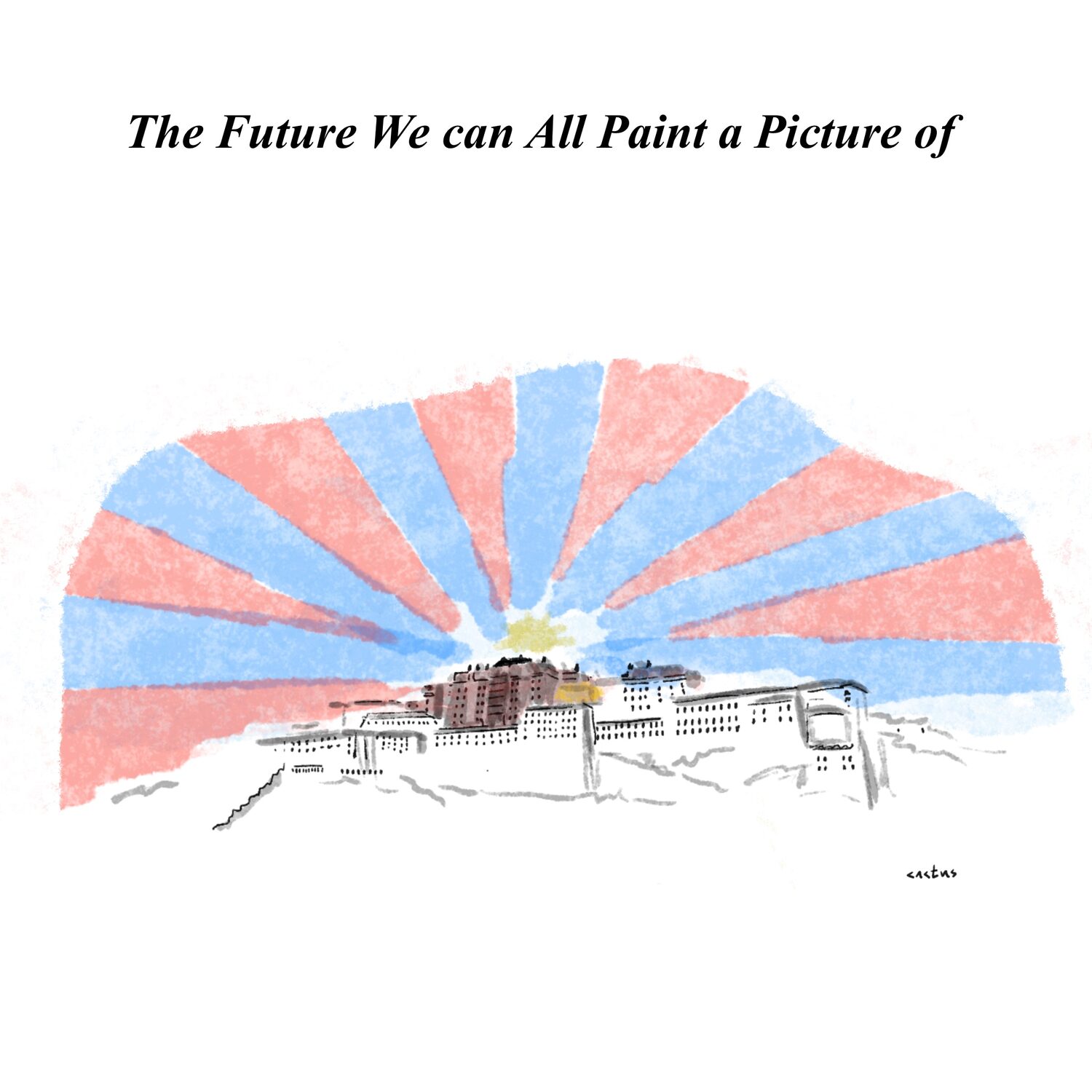
This was not always so. In the early 1960s, the debate was—paradoxically, despite the traumatic experience of a lost war—marked by an optimistic faith in the future and a discourse on Tibetan modernity. The democratic constitution for a free Tibet is an expression of that.
The most intriguing official proposal to emerge from this context was, in my view, the idea of a Zone of Peace.4 In 1989, following the award of the Nobel Prize, the Dalai Lama finally had the opportunity to present his vision for the future of Asia in detail to a broader public. It is a tragedy—and at the same time a proof of the validity of the Allegory of the Cave—that in the years that followed, this text received virtually no attention in either the Tibetan or the international public sphere, and was never developed further.5 There is not a single publication that engages with the philosophical, geopolitical, economic, or social implications of this idea.
The Zone of Ahimsa can be understood as an attempt to offer, in the Asian context, a universal answer to the fundamental questions of justice and the good life. A reconciliation of spiritual values with the demands of a modern world that had just freed itself from the Cold War is set out in remarkably clear and accessible concepts. Read in light of today’s geopolitical upheavals, the ideas for a Peace Zone appear as the core of a peace and security plan for 21st-century Asia. Regrettably, however, it does not offer a recipe—it is an invitation to think. An overreach, it seems, for the Tibetans in exile, who were busy chasing the carrot that Beijing dangled before them until the de facto breakdown of negotiations in 2008.
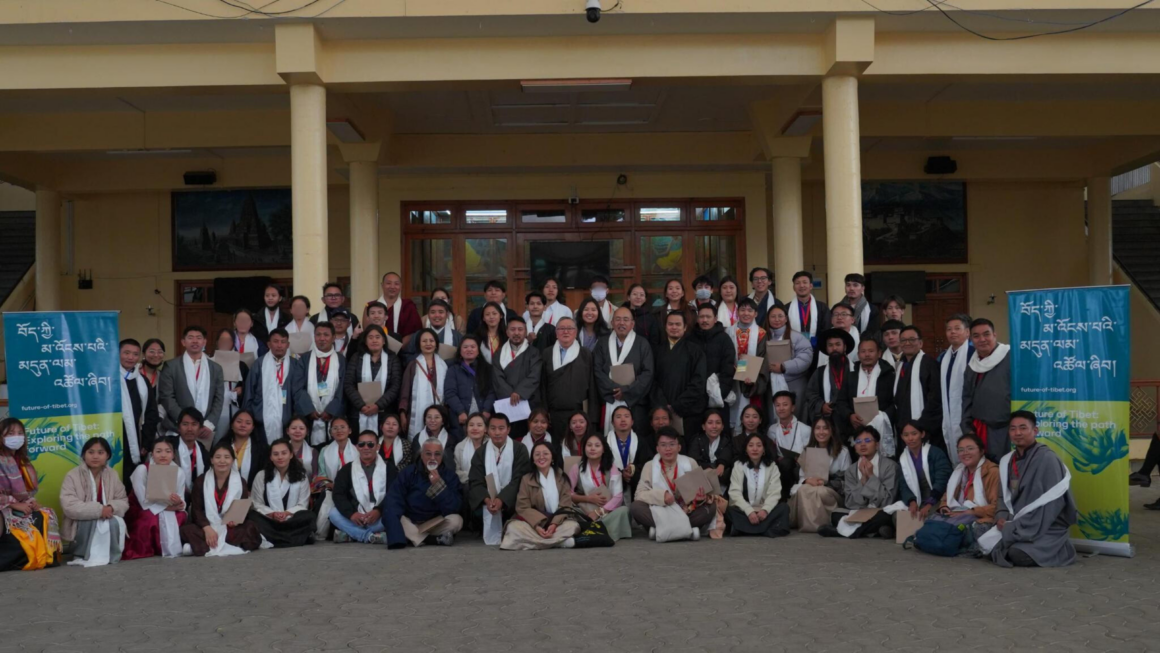
The Future of Tibet Conferences were an attempt at a fresh start—to fill a vacuum.6 The group succeeded in developing a methodology for speaking about the future, detached from the unproductive debate between independence and autonomy. More important to this scenario crafting was an understanding of the role narrative structures play in exploring the future. They outline intermediate steps and possible paths, including limited points of intervention. Participants realised they are part of the story. As in real life, some things are beyond control; focusing on what can be influenced is empowering. But a geopolitical reflection on these scenarios, and a deeper political-philosophical grounding of them, remains outstanding.
It is high time, therefore, for a new round of ‘Future of Tibet’ conferences—this time with an expanded circle including Trans-Himalayan representatives from Inner Asia, India, and China.
References
- Such a system of international relations could, in my view, be conceived under the assumptions of both defensive and offensive realism as represented by Kenneth Waltz and John J. Mearsheimer. ↩
- Much has already been written on this topic. What is often overlooked in the consistently very pessimistic forecasts is the following: viewed soberly, Tibet holds an advantage over China when it comes to the succession process of its leadership. The procedure is well established and typically results in an outcome endowed with considerable charisma and legitimacy. In theories of successful statehood, factors such as leadership succession and the presence of future-oriented visions play a major role. Both can be affirmed in the case of Tibet. In this context, I would also refer to resilience research, particularly Indian scholarship (i.e., Girija Saklani on the Tibetan refugee community), which concludes that the Tibetan exile community possesses a well-tested and high degree of resilience. If resilience is required for such a long game, Tibetans may have it. ↩
- Plato's Allegory of the Cave offers a basis for critically examining our assumptions of political systems, including the leader's qualities. Socrates clearly did not have revolutionary communist agitators in mind when discussing the qualities of a philosopher statesman with Adeimantus. It is worth noting that interest in the Greek classics, nonetheless, has recently grown in China, some intellectuals even wrongly suggesting some resemblance to Confucius; in this context, see Plato Goes to China: The Greek Classics and Chinese Nationalism (Princeton University Press, 2023) by Shadi Bartsch. ↩
- The Dalai Lama referred to it as a "Zone of Peace" or "Zone of Ahimsa." See, for comparison, his Nobel Lecture in Oslo at the Nobel Prize: https://www.nobelprize.org/prizes/peace/1989/lama/lecture/ ↩
- It is a regrettable omission that this forward-looking text, which could have provided a counterpoint to the "Memorandum on Genuine Autonomy for the Tibetan People," was not included in the appendix of Voice for the Voiceless. ↩
- This series of four conferences from 2020 to 2023 was a civil society initiative by Tibetan activists, students, and academics. Four scenarios were developed and visualised: one highly positive, one pessimistic, and two shaped by missed opportunities and by stagnation. A substantial document with four scenarios were published in 2024. See here for more: https://future-of-tibet.org/en/ ↩