TransHimalaya
Dreshey
From the Archives
Two documents that frame the dispute over Tibet’s status, read side by side.
1913
Proclamation Issued by H.H. the Dalai Lama XIII
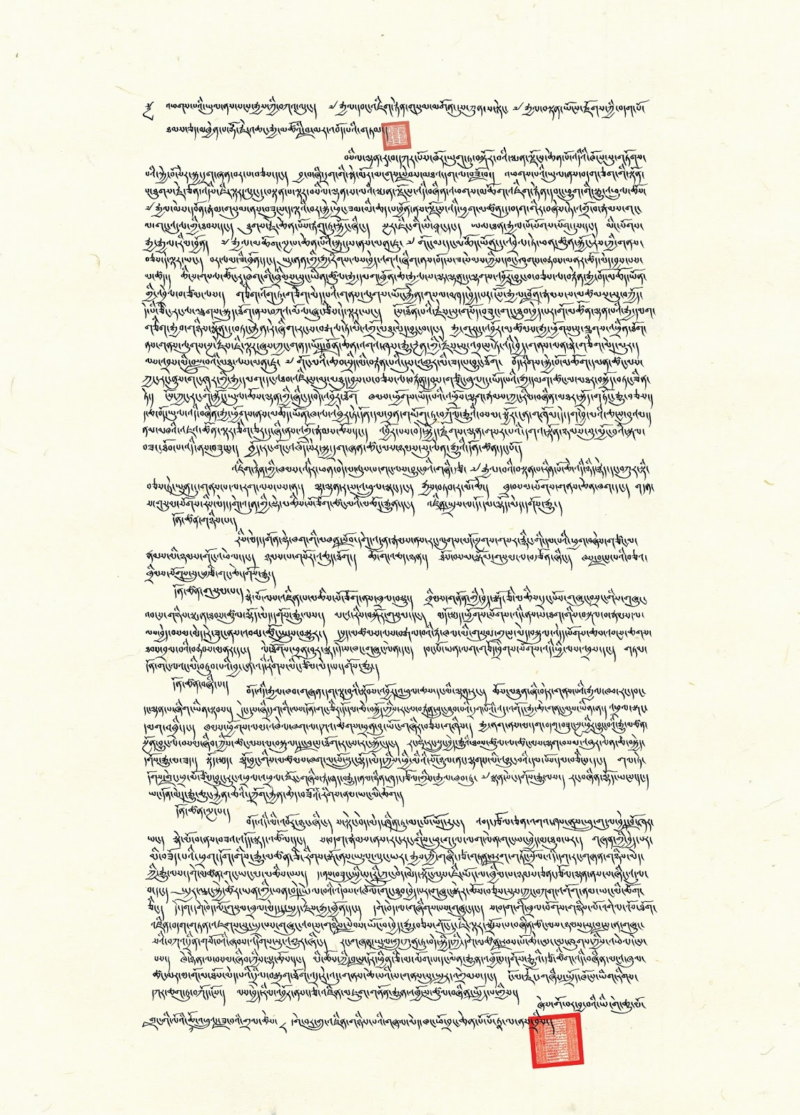 Source: Re-creation of the original proclamation by Students for a Free Tibet. The English translation of this proclamation is translated on the book – Tibet a Political History, Tsepon W.D. Shakabpa, Yale University Press, 1967, pp 246-248
On the eighth day of the first month of the Water-Ox Year (1913), His Holiness the 13th Dalai Lama issued a proclamation reasserting the independence of Tibet. Following the collapse of the Manchu Qing Empire and the expulsion of Chinese forces from Tibet, he declared that Tibet had regained its freedom and would govern itself as a small, religious and independent nation. He emphasised that the historical relationship between Tibet and China had been one of priest and patron rather than political subordination.
The proclamation called for the preservation of Buddhism and its institutions, the protection of religious traditions, just and humane governance, the abolition of harsh punishments, vigilance in safeguarding Tibet’s independence, and the responsible development of the country’s resources and agricultural lands. It concluded by urging all Tibetans to work collectively for the prosperity, security and independence of Tibet.
From 1912 until the entry of the People’s Liberation Army in 1950–51, Tibet exercised many of the functions of an independent state, including maintaining its own government, army, currency and foreign relations.
1992
The PRC White Paper, Tibet — Its Ownership and Human Rights Situation
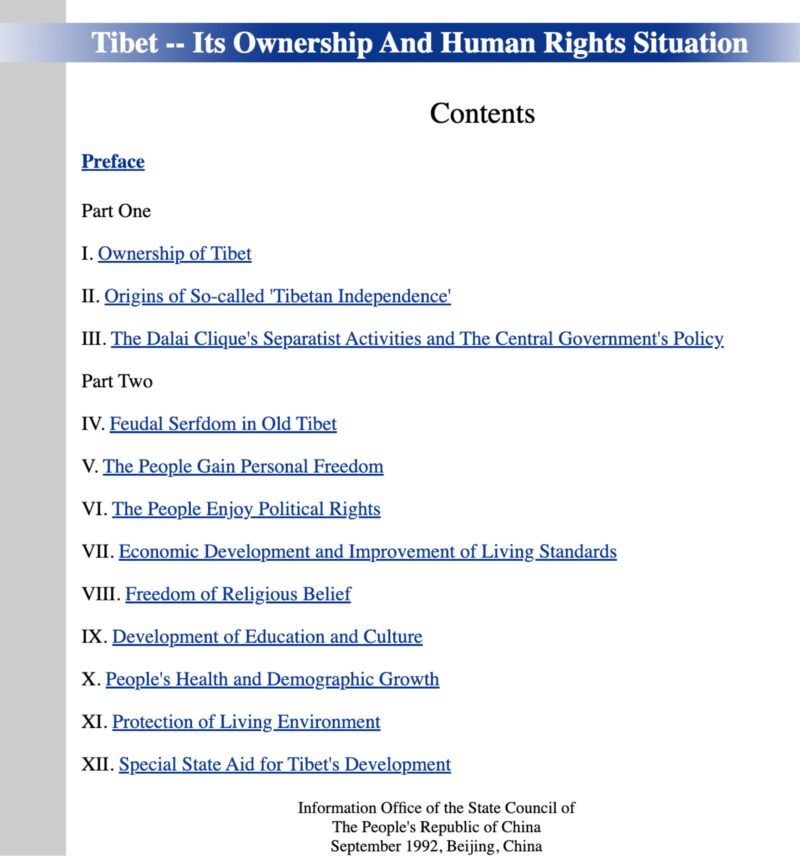
Source: Embassy of the People’s Republic of China in Ireland.
One of Beijing’s earliest and most comprehensive attempts to justify its rule over Tibet, this document runs to more than 37,000 words. It presents Tibet as an inseparable part of China since ancient times, dating its incorporation to the Yuan Dynasty; portrays the 1951 Seventeen-Point Agreement as a voluntary acceptance of Chinese sovereignty; describes the 1959 Tibetan uprising as a rebellion by the Dalai Lama and the old elite to preserve a feudal system; and credits the Chinese Communist Party with liberating a million serfs, abolishing slavery, and transforming Tibet through economic development, education, healthcare and religious freedom. Any suggestion that Tibet was historically independent is dismissed outright.
For Tibetans and many outside observers, the white paper reads less as a historical account than a political defence of Chinese rule. It largely ignores that Tibet functioned independently for decades before the PLA’s arrival in 1950, maintaining its own government, army, currency, postal system and diplomatic contacts. The International Commission of Jurists, investigating Tibet in 1959 and 1960, concluded that Tibet had demonstrated the essential characteristics of statehood prior to 1950 and that the Tibetan people had been denied the right to self-determination.
The paper is also difficult to reconcile with the Seventeen-Point Agreement itself, which explicitly promised that Tibet’s existing political system and the status of the Dalai Lama would not be altered — assurances steadily eroded in the years that followed. Its treatment of human rights is similarly selective: at the time, Amnesty International and Human Rights Watch were documenting political imprisonment, torture and severe restrictions on religious practice in Tibet, a picture very different from the one the white paper describes.
Key international reactions included:
- Central Tibetan Administration: called it propaganda filled with “misinterpretation, misconceptions, and lies,” noting it failed to address Tibetan grievances or acknowledge Tibet’s separate history.
- Human Rights Watch: its 1992 World Report documented extensive political imprisonment, torture and restrictions on religious freedom in Tibet, directly contradicting the white paper’s claims.
- Amnesty International: published a 1992 report on rights violations against Tibetan minorities, including the detention and torture of peaceful activists.
- International Campaign for Tibet: later dismissed the white paper series as “false propaganda” and a “whitewash” that acknowledged China’s policy failures by blaming the Dalai Lama.
- US State Department: included Tibet in its annual human rights reports documenting repression, religious restrictions and cultural assimilation.
The white paper established the template for China’s subsequent Tibet documents — what critics have called “a lie repeated a thousand times” that erases Tibetan history while labelling criticism of it as “separatism”.
Stay Connected
Subscribe to our newsletter for the latest stories, insights, and opportunities from the Himalayas.