Cultural Erasure: China’s Assimilation of Southern Mongolia
For nearly eight decades, the Chinese state—and tens of millions of ordinary Chinese settlers acting alongside it—has pursued a relentless settler-colonial project in Southern Mongolia, with the People's Republic of China (PRC) renaming the Mongolian homeland as 'Inner Mongolia'. What is now unfolding under the cultural-genocide policies launched in 2020 is not a new development, but the finishing touch on this long project—the final solution to the Mongolian question, intended to wipe out Southern Mongolia as a nation once and for all.
For nearly eight decades, the Chinese state—and tens of millions of ordinary Chinese settlers acting alongside it—has pursued a relentless settler-colonial project in Southern Mongolia, with the People’s Republic of China (PRC) renaming the Mongolian homeland as ‘Inner Mongolia’. What is now unfolding under the cultural-genocide policies launched in 2020 is not a new development, but the finishing touch on this long project—the final solution to the Mongolian question, intended to wipe out Southern Mongolia as a nation once and for all.
Eighty Years of Settler Colonisation
The Chinese Communist Party (CCP) established the Inner Mongolia Autonomous Region on 01 May 1947, two years before the founding of the PRC itself. Branded as a model of ethnic self-determination, it was in fact deliberately drawn to absorb vast Chinese agricultural districts, guaranteeing that Mongolians would never hold demographic dominance in their own homeland. From the 1950s onward, the state directed wave after wave of Chinese settlement onto the grasslands, but the project was never confined to government planners. It was carried out, populated, and profited from by ordinary Chinese peasants and other settlers who arrived by the millions to claim pasture, plough it under, open mines, and build cities atop displaced Mongolian communities. Settler colonisation in Southern Mongolia has been a popular Chinese national project, not merely a regime policy.
The era of 1960s and 1970s made the violence of that project explicit. The fabricated ‘Inner Mongolian People’s Revolutionary Party’ purge of 1967–1969 unleashed a textbook example of a genocide campaign: tens of thousands of Mongolians—conservative figures begin at 22,900 dead, with credible accounts citing 100,000 or more—were tortured or killed, and hundreds of thousands were persecuted on fabricated charges of separatism. The post-genocide era then opened the grasslands to industrial-scale dispossession through mining, agribusiness, and the forced sedentarisation of nomadic herders. By the 2010 census, Mongolians made up only about 17 percent of the region’s 24 million inhabitants. They are today a small minority on their own ancestral soil.
2020: The Cultural Genocide Climaxes
If the preceding decades hollowed out the material foundation of Mongolian life, the policies launched in August 2020 began the systematic dismantling of its cultural foundation. Beginning that autumn and intensified every year since, Chinese authorities have moved not merely to reduce, but to eliminate, the Mongolian language and every visible marker of Mongolian identity in Southern Mongolia.
The Mongolian language has now been completely banned as a medium of instruction in every school in Southern Mongolia, from kindergarten through university. Every subject in every grade is taught exclusively in Chinese. Mongolian-language textbooks have been pulled, Mongolian-speaking teachers have been reassigned or dismissed, and Mongolian-language schools have either closed outright or been stripped of their character and converted into Chinese-language institutions. Beyond the schoolhouse, the language has been driven out of all social and public life: erased from government documents and proceedings, courtrooms, hospitals, banks, public signage, billboards, shop fronts, broadcast media, websites, mobile applications, and even from official place names rendered in the traditional Mongolian script.
The campaign reaches far beyond language, anything that bears Mongolian characteristics has been targeted for suppression. Mongolian-language publishing houses have been shuttered or absorbed, Mongolian books have been pulled from libraries, and Mongolian social media accounts have been deleted en masse. The traditional Deel and other markers of national dress are discouraged in schools and workplaces. Naadam festivals, Genghis Khan commemorations, monasteries, shrines, and historic sites have been placed under tightening ideological supervision or rebranded as generic ‘Chinese’ heritage stripped of any Mongolian meaning. Writers, historians, musicians, teachers, and herder activists have been arrested, surveilled, dismissed, or driven into exile. Even private gatherings where Mongolian songs are sung, reciting Mongolian poetry, or teaching children the Mongolian alphabet at home have been treated as suspect, monitored by neighbourhood committees, and in some cases prosecuted as ‘separatism’ or ‘inciting subversion of state power’.
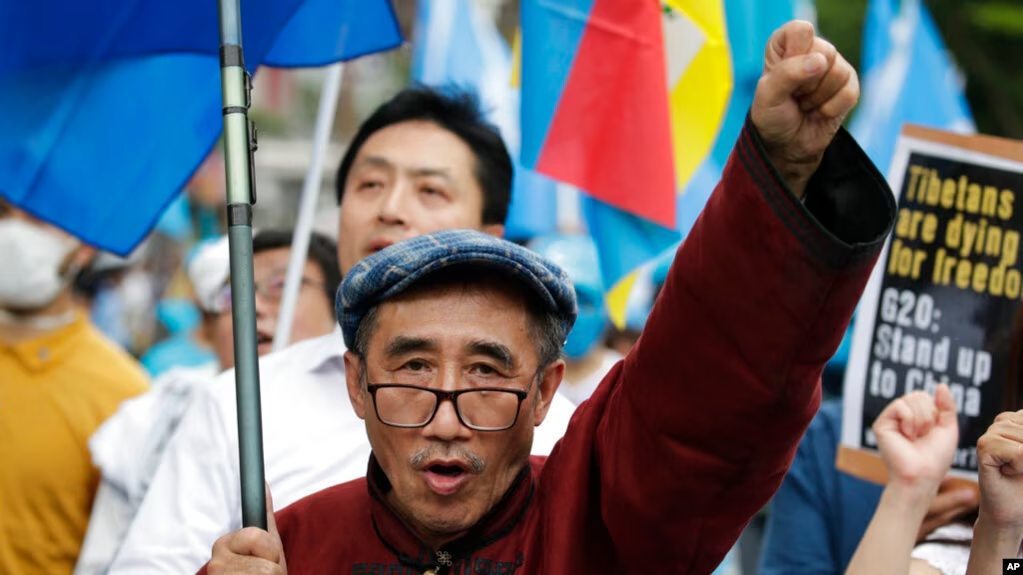
When parents, teachers, and students mounted the largest protest the region had seen in decades—mass school boycotts and street demonstrations against the August 2020 policy—the state responded with mass arrests, dismissals, school lockdowns, electronic surveillance, and threats against any state employee whose child stayed home. Several Mongolians, including the teacher Ulaan, government official Surnaa, and a ninth-grade student, took their own lives in despair. The policy, however, did not retreat. In fact, it expanded.
‘Forging the Chinese Nation’: Compulsory Indoctrination
Layered atop these prohibitions is a positive programme of forced ideological assimilation. The entire Mongolian population including students, civil servants, herders, monks, retirees, even small children is now subjected to the campaign known as ‘forging a strong sense of community for the Chinese nation’ (铸牢中华民族共同体), Xi Jinping’s signature ethnic policy. Through mandatory study sessions, loyalty pledges, workplace examinations, neighbourhood meetings, and saturation propaganda in every village and every community, Mongolians are required to renounce any distinct national identity and absorb themselves into a singular ‘Chinese nation’ defined by the language, culture, and political authority of the Chinese majority. Non-participation is not permitted, visible enthusiasm is rewarded, quiet refusal can cost a job, a pension, or a child’s school placement.
The Final Solution
Chinese officials and state commentators have, in effect if not always in name, presented this campaign as the definitive resolution of what Beijing calls the ‘Mongolian question’. It is the final solution: not merely the suppression of dissent, but the planned termination of Southern Mongolia’s existence as a distinct nation. After nearly 80 years of land seizure, demographic submergence, mass political violence, and grassland enclosure, the cultural genocide unleashed since 2020 is the finishing touch—the closing move of a settler-colonial project that has worked, generation by generation, to ensure that the Mongolian people, language, script, and homeland are absorbed without remainder into the homogenous Chinese state.
The land will remain. Whether anything recognisable as the Mongolian nation survives the coming decade depends on whether the world is willing to name what is happening, cultural genocide, and to act on it before the project Beijing has openly described as final achieves what it set out to do since 1947.